

Every few weeks another headline announces that AI search has killed publishing. The numbers attached to those headlines are frightening, specific, and often wrong. That is the awkward shape of the current moment. The threat to publishers is real and measurable, but it travels wrapped in a layer of statistics that fall apart the moment you check them.
This guide started as a response to one of the better-known rallying cries on the topic, John Shehata’s “Publisher Survival Playbook: 11 Critical Actions for the AI-First Era” (NewzDash, May 2025). The actions in it are mostly sound. But before turning them into advice for a smaller publisher, we did the thing the genre usually skips: we traced every alarming number back to its primary source. Some held up. Several didn’t. What follows keeps the parts that survived, drops the parts that didn’t, and reframes the whole thing for the publisher this advice tends to ignore: the small or mid-size EU and diaspora outlet without an enterprise budget.
The threat is real. The numbers around it often aren’t.
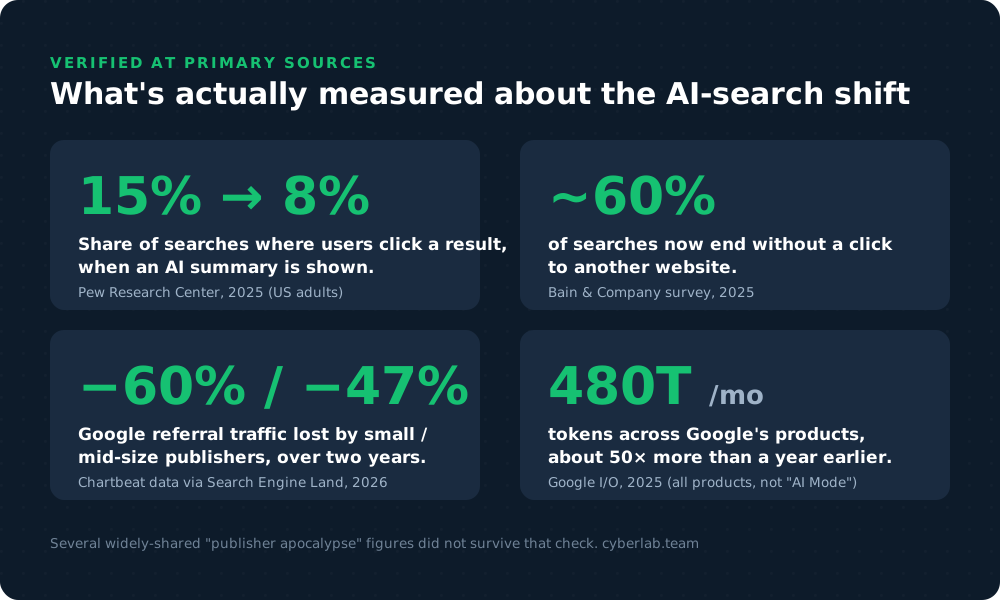
Something genuinely changed in how search sends traffic. Pew Research measured it directly in July 2025 (US adults): when an AI summary appears at the top of results, the share of users who click through to a website fell roughly from 15% to 8%. Bain’s February 2025 survey found around 60% of searches already end without any click at all (again, a US-leaning panel, directional for other markets). And Chartbeat, tracking actual referral data across thousands of sites via Search Engine Land (2026), found small publishers lost about 60% of their Google search referral traffic over two years, mid-tier sites about 47%. Those three numbers are independently sourced, and they point the same direction.
So no, this isn’t a vendor scare cycle.
What is a scare cycle is the layer of statistics bolted onto the real trend. You will see claims about AI answers citing “13 to 39 sources per answer,” affiliate revenue dropping “50 to 70%,” click-through rates collapsing “40 to 57%.” Trace those figures to their sources and they either vanish or point to something far narrower than the headline implied. We checked. They didn’t survive.
That gap matters in practice. Publishers who bought tactics off the scary version of the numbers paid real costs for a threat they had already inflated: rushed pivots, expensive tooling, content strategies built around behaviour that was never actually confirmed. The verified data is bad enough to act on. The fabricated layer mostly adds noise.
Set independence targets you can measure
The core idea in the playbook, don’t let one traffic source control your revenue, is sound. That is just risk management, and it applied before AI search too. What makes it actionable is picking targets you can actually observe: numbers your own analytics already produce, written down this month and checked again in six.
What doesn’t hold up are the specific revenue figures the playbook quoted for newsletters and licensing. Real newsletter-to-paid conversion sits near a 0.6% median for most publishers, per beehiiv’s 2026 data, not the 8 to 12% range that circulates as a benchmark. AI-licensing deals are real but large and annual (Dotdash Meredith reportedly $16M a year with OpenAI; News Corp over $250M across five years). Monthly licensing tiers for small publishers are mostly undisclosed and unproven. Don’t build a model on numbers like those.
The underlying goals still make sense. If search currently delivers more than half your traffic, that is a real concentration risk worth reducing. Single-channel dependence on any platform has always been fragile, with or without an AI apocalypse. Targets a small publisher can actually move: grow the share of direct visits and email opens; test one non-advertising revenue stream (memberships, paid content, events) to learn what your audience will pay for; note what percentage of traffic arrives from search this month, and check it again in six. A small site’s numbers won’t look like Morning Brew’s. But they are observable, which makes them better navigation than viral projections.
Change what you count
Raw clicks from Google are a worse compass than they used to be. They still matter, but they now measure a narrower thing. A page that earns a citation in an AI answer can generate impressions, brand familiarity and return visits without ever logging a referral click. Counting only clicks misses that.
Semrush data via Digiday (March 2025) found the share of tracked keywords triggering an AI Overview jumped sharply for some large publishers in six months: ProPublica up 204%, BuzzFeed up 172%, Rolling Stone and Vanity Fair up 164%. Digiday was careful to flag that this measures exposure to AI answers, not proven traffic loss, and that distinction matters. More AI-answer appearances can come with more impressions even while clicks fall. Watch clicks alone and you can’t tell apart a site being left behind from one that’s getting cited and simply not clicked.
For a publisher without an enterprise analytics stack, the practical shift is modest. Search Console now reports impressions from AI features separately, so check it. Track email-list growth and open rates as a proxy for loyalty that doesn’t depend on any algorithm. Revenue per visitor matters more than total visitors when referral volume is shrinking: fewer people but the same revenue means your audience got more valuable. And treat any third-party “AI visibility score” with the skepticism Google itself recommends, because the methodologies are proprietary and aren’t standardised across tools.
Optimize to be cited, not just ranked
The mechanics that get you pulled into an AI answer turn out to be mostly the same ones that get you ranked in ordinary search. Clear structure, real author expertise, schema markup, being referenced by other credible sites: this is the trust-and-quality work SEO practitioners have argued about for years. None of it is new, and the consultants selling a separate “GEO” playbook are largely repackaging it.
That convergence is the heart of what we covered in good SEO is good GEO: Google has said plainly that its generative features draw from the same index and the same quality signals as organic search. Earn trust in one system and you tend to earn it in both.
A few things do tilt the odds more specifically toward AI citation. Pew found that 88% of AI summaries cite three or more sources (Pew Research Center, July 2025; US adults), so models are assembling answers from several voices, not one. Being the site with the clearest, most structured take on a topic (not just the most trafficked) matters. Schema helps Google understand what a page is about and who stands behind it. And being mentioned on independent third-party sites gives a model something to corroborate against. None of this guarantees a spot in any particular answer; it just lowers the friction and raises the probability. If that direction is useful to you, our AI visibility work starts by measuring where you actually stand today, before any changes.
Write the things a model can’t synthesize
The most durable answer to AI-generated content is content a model couldn’t cheaply produce in the first place. Such material always starts with something you did rather than something you read: you were present, you measured it yourself, you took a position you will sign, or you covered a place too small for anyone else to bother with.
That means first-hand reporting: the thing your team actually witnessed, measured, or heard from a specific source. It means a genuine point of view, a conclusion you are willing to put your name to rather than a balanced shrug. It means original data, even modest data: a survey of your own readership, a price comparison you ran yourself, numbers from your own analytics.
For a small EU publisher, the local or niche angle is often the strongest lever. A Polish e-commerce site tracking CPM swings in the złoty market has something no global outlet will bother to produce. A Ukrainian publisher covering diaspora news in Germany serves an audience nobody else covers at that granularity. A model trained on the broad English-speaking web cannot synthesise those angles, because they aren’t in the training data. This is also what travels in Google Discover, which rewards content people want to read unprompted rather than content answering a generic query. We go deeper in our Google Discover guide, but the short version is the same: write what only you can write, and the distribution tends to follow.
Own the audience: email, app, community
The one channel Google can’t adjust overnight is a direct line to your readers. An email list, push notifications, a community space, an app: anything where the reader opted in and you can reach them without an algorithm in the middle.
This is action 5 in the playbook, and it’s the right instinct. But the number attached to it needed checking. The playbook floated “8 to 12% paid newsletter conversion” as a benchmark. That’s a ceiling, and a high one; beehiiv’s 2026 platform data puts the median paid conversion near 0.6%. If you’re starting from scratch, build for that range and treat double digits as the exception. The point of an owned list isn’t to replace ad revenue on day one. It’s to survive a week where search referrals drop 40% and your direct audience still shows up.
Start simpler than you think you need to. A signup on the article page, a basic weekly digest, plain writing about what subscribers actually get. A few hundred engaged readers who open reliably are worth more than ten thousand addresses that don’t. They are the readers who convert to a paid tier later, recommend you to colleagues, and click an affiliate link because they trust the judgment behind it. App and push channels are worth adding once you publish consistently, but each one carries an upkeep cost. Pick one and make it work before opening another.
Spread out where you show up
One traffic source is a liability, and the Chartbeat figures from the start of this guide are what that liability looks like when it shifts. The fix is unglamorous: more than one way in.
YouTube and video are the most defensible diversification play for most publishers. The CPM argument is real. Video usually earns roughly two to four times the CPM of standard display, by various vendor benchmarks, though the exact figure moves with format and market. More to the point, YouTube is a search engine of its own, and video compounds over time instead of decaying the way a news article does. Social platforms distribute content, but you own the audience there no more than you own your Google traffic; use them for reach, and don’t mistake reach for a durable asset.
Google Discover is the surface publishers most underrate. It sends traffic to content nobody searched for, a discovery loop that can rival search referrals once you’re eligible. Eligibility comes down to a few fixable things: correct image specs, honest headlines, clean E-E-A-T signals, a technically sound page. Our Google Discover guide covers what actually moves the needle there. Podcasts and newsletters overlap with owned audience by design. The channels that build direct reach are the same ones that widen distribution without a platform in charge. Every new channel is real, ongoing work, though. Add one at a time, and measure before adding the next.
Build first-party data the clean way (an EU advantage)
Third-party cookies are fading. Google’s deprecation timeline has slipped, but the direction hasn’t changed, and Safari and Firefox already block cross-site tracking by default. What fills the gap is first-party data: email addresses, reader preferences, logged-in sessions, on-site behaviour, all collected with clear consent from people who chose to give it.
For EU and diaspora publishers, the GDPR framing often feels like a burden. It doesn’t have to. A clean, consented first-party data setup is exactly what the regulation rewards, and it puts you ahead of publishers who collected data sloppily for years and now face a harder cleanup. Consent that was given properly, documented properly and can be withdrawn properly is worth more to an advertiser than a bigger database of murky provenance. That isn’t a legal argument; it’s a commercial one.
In practice the setup isn’t complicated. A consent form that explains plainly what the reader is agreeing to. Preferences stored where you can act on them: topics, formats, language. A logged-in state if your platform supports it, which upgrades your analytics from session guesses to known readers. Start with email: even basic segmentation, like which topics a subscriber clicked last month, makes your sponsorship and affiliate pitches more defensible to buyers. Advertisers who care about brand safety increasingly ask about data provenance, and a publisher in Estonia or Poland with a documented consent process can answer that cleanly. Most can’t.
Stop leaning on a single revenue line
Ad revenue is the most exposed position in the feed right now. When an AI summary answers a query before anyone clicks, display impressions fall before you notice. If advertising is the only line on your income statement, there is no buffer.
The options for a smaller publisher are real, though none is quick or automatic. Membership and subscriptions get the most attention. The Financial Times built an AI-assisted paywall that reportedly lifted conversions about 290% (a relative lift, via Digiday; treat it as directional, not a rate to expect). Morning Brew reached roughly $50M in 2021, almost entirely from advertising, on a base of 4M+ newsletter subscribers (CNBC, company-disclosed). Stratechery was estimated at around $3M from about 26,000 subscribers paying $120 a year, an analyst estimate via Business Insider dated 2020. Real businesses, but ones that took years and audiences that were already large and loyal. Paid-newsletter conversion is usually far below those headlines, near a 0.6% median (beehiiv, 2026). Build on that floor, not the ceiling.
Events, consulting and productised expertise often convert better for a small specialist site than a paywall does. If your readers trust your judgment on, say, regional ad markets or publisher monetization, a workshop or a short advisory engagement can earn real revenue from a few dozen loyal readers. AI licensing, by contrast, isn’t a small-publisher play yet: the deals that have closed are large and annual, and monthly micro-licensing tiers for independent sites remain mostly unannounced. Don’t plan around a cheque that hasn’t arrived.
The honest framing is that diversifying revenue is a structural shift, not a campaign. Start with the product that fits your audience now, test it at small scale, and treat ad revenue as one input rather than the whole.
You have more leverage together than alone
A publisher with 50,000 monthly readers cannot negotiate with Google or OpenAI. A coalition of publishers representing tens of millions can have a different conversation. Alliances are slow, and joining one is how a small publisher gets into the room where AI licensing and copyright get decided. Your traffic and revenue numbers only carry weight as part of an aggregate.
Industry alliances are slow, often frustrating, and still worth joining. The European Publishers Council and national press associations have pushed on AI licensing, copyright and platform accountability for years, and that work fed directly into the EU AI Act and the debates around the Digital Markets Act. Both create obligations for large platforms that simply don’t exist in the US. For a European publisher that backdrop is a genuine edge: EU copyright law already gives more standing than US fair-use doctrine when it comes to how AI systems train on published content. The Digital Markets Act, in particular, designates the largest platforms as “gatekeepers” and imposes fairness and interoperability obligations. Whether enforcement keeps pace with the technology is a separate question, but the framework exists, and it shifts the baseline when collective licensing is on the table.
Practically, the first step is just being present: join your national publishers association, follow what groups like the European Publishers Council file with regulators, and respond when they ask members to document traffic and revenue losses. Individual data points become useful in aggregate. None of this is a fast fix. Regulatory processes run on years, and collective licensing has stalled before it concluded. But how AI systems source and cite content will be shaped partly by pressure that small publishers have more of, collectively, than they realise, especially in a jurisdiction that has already decided large platforms need oversight.
Follow the signal, not the panic
The playbook ends with a call to follow industry voices and stay current on guidance from Google and Bing. That is sound advice; the people doing rigorous tracking of how AI systems behave are worth reading.
But there is a quieter lesson underneath this entire guide, and it’s worth saying outright. A large share of the numbers circulating about AI’s impact on publishing don’t hold up when you trace them back. Some were projections presented as measurements. Some were measurements from a small US-leaning panel presented as global facts. Some appear to have been invented, and aren’t in the sources cited at all. That’s not a knock on the people sharing them; the space moves fast and the incentive to sound authoritative is strong. But a publisher reorganising their business around a statistic that dissolves on inspection is doing themselves harm.
The habit worth building is simple. When a number alarms you, ask who produced it, when, and whether the original source says what the summary claims. Primary sources are almost always findable. When they aren’t, that itself is information.
Where this leaves a smaller publisher
Strip away the panic and the survival plan is unglamorous. Reduce how much of your business rests on one platform. Earn citations by doing the quality work, not by buying a separate trick for the machines. Write the things only you can write. Build a direct line to your readers and treat it as the asset it is. Spread your revenue across more than one line. And in Europe, use the regulatory weight and collective standing that US publishers don’t have.
None of it is fast, and none of it is guaranteed. The surfaces shift every month, and nobody, us included, can promise you a spot in an AI answer or a traffic number. The realistic goal is the durable one: own the relationship with your audience, so that when any single channel turns against you, your business doesn’t turn with it. If you want help finding where you actually stand, which share of your traffic and revenue is exposed and which lever is worth pulling first, that is where our publisher monetization and news site audit work begins.
Sources
- John Shehata, NewzDash, “The Publisher Survival Playbook: 11 Critical Actions for the AI-First Era” (the guide that prompted this piece), May 2025. https://www.newzdash.com/guide/publisher-survival-playbook-11-critical-actions-ai-first-era
- Pew Research Center, “Google users are less likely to click on links when an AI summary appears” (15% to 8% click share; 88% of summaries cite 3+ sources; US adults), July 2025. https://www.pewresearch.org/short-reads/2025/07/22/google-users-are-less-likely-to-click-on-links-when-an-ai-summary-appears-in-the-results/
- Bain & Company, “Consumer reliance on AI search results signals new era of marketing” (about 60% of searches end without a click), February 2025. https://www.bain.com/about/media-center/press-releases/20252/consumer-reliance-on-ai-search-results-signals-new-era-of-marketing--bain--company-about-80-of-search-users-rely-on-ai-summaries-at-least-40-of-the-time-on-traditional-search-engines-about-60-of-searches-now-end-without-the-user-progressing-to-a/
- Search Engine Land, “Small publisher search traffic fell 60% over two years” (Chartbeat data), 2026. https://searchengineland.com/small-publisher-search-traffic-drops-data-471974
- Digiday, “Keywords can help publishers see Google’s AI Overviews impact” (Semrush AI-Overview trigger data: ProPublica +204%, BuzzFeed +172%, Rolling Stone/Vanity Fair +164%), March 2025. https://digiday.com/media/measuring-googles-ai-overviews-impact-keyword-data-ctrs-for-publishers/
- Digiday, “Why publishers fear traffic, ad declines from Google’s AI-generated search results” (Raptive’s ~$2B at-risk estimate), May 2024. https://digiday.com/media/why-publishers-fear-traffic-ad-declines-from-googles-ai-generated-search-results/
- Press Gazette, “Google AI Overviews leading to affiliate revenue drop of 20-40% at some publishers,” October 2025. https://pressgazette.co.uk/press-gazette-events/google-ai-overviews-leading-to-affiliate-revenue-drop-of-20-40-at-some-publishers/
- beehiiv, “The State of Paid Newsletters 2026” (median paid conversion near 0.6%). https://www.beehiiv.com/blog/the-state-of-paid-newsletters-2026
- Google, “Google I/O 2025: Sundar Pichai’s keynote” (480 trillion tokens/month across products, about 50× year-over-year). https://blog.google/innovation-and-ai/technology/ai/io-2025-keynote/
- CNBC, “Morning Brew tops 4 million newsletter subscribers” (about $50M 2021 revenue, company-disclosed), March 2022. https://www.cnbc.com/2022/03/28/morning-brew-tops-4-million-subscribers-as-it-looks-to-expand-with-ma.html