

If someone has told you your rankings are at risk from “toxic backlinks,” take a breath. For most sites, a handful of spammy links pointing at you changes nothing. Google throws away the large majority of low quality links before they ever touch your rankings. The panic you have probably been sold sits on top of a small kernel of truth, and the gap between the two is where a lot of small-business money gets wasted every month.
Here is the calm version, and the short list of situations where the worry is actually justified.
What people mean by “toxic backlinks”
The phrase is mostly a marketing label from SEO tools, not something Google says. In practice people mean spammy, manipulative, or low quality links you never earned: link farms and private blog networks with obvious footprints, AI-generated spam sites, scraped blog-comment and profile links, sudden bursts of exact-match anchor text, and links from odd throwaway domains. None of that is flattering to see in a report. Very little of it matters on its own.
What does Google actually do with them?
The turning point was Penguin 4.0 in 2016. Google folded link evaluation into its core algorithm and made it run in real time. The shift that matters for you: since then Google devalues bad links instead of demoting your site for them. It recognizes the junk, ignores it, and simply does not let it count.
This is also why classic negative SEO is much weaker than it sounds. When a competitor points a pile of garbage links at your site, Google can usually tell the junk is not your doing and discounts it, as long as your overall profile looks normal. It is not a guarantee, but for an ordinary local business the odds are heavily in your favor.
“But the leak proved toxic links are real”
Here is the claim I want to correct, because the article that prompted this piece leans on it and you will see it repeated everywhere. People point to internal Google field names like siteAuthority and badBacklinksPenalized as proof that toxic links tank you. Two caveats.
First, the attribution. Those field names came from the May 2024 Google Content Warehouse API leak, more than 2,500 pages of documentation and about 14,000 attributes pulled from Google’s own public code repository. They did not come from the Department of Justice antitrust trial, which is a separate event that people often blend together. If a source tells you “the DOJ leak revealed BadBackLinksPenalized,” the source has the wrong event.
Second, and more important: a leaked field name is not a scoreboard. The documents list attribute names with no weights, no thresholds, and no confirmation of how, or even whether, each one is used in the live system today. A flag called badBacklinksPenalized tells you Google has the machinery to mark a manipulated profile. It does not tell you that your fifteen scraper links are dragging you down. Both are true at once, and only one of them is about you.
So both loud voices are a little off. Google’s “we just ignore it” is not perfectly true. The tool industry’s “clean your links every month or you will be penalized” is fear with a price tag attached.
So when does it actually matter?
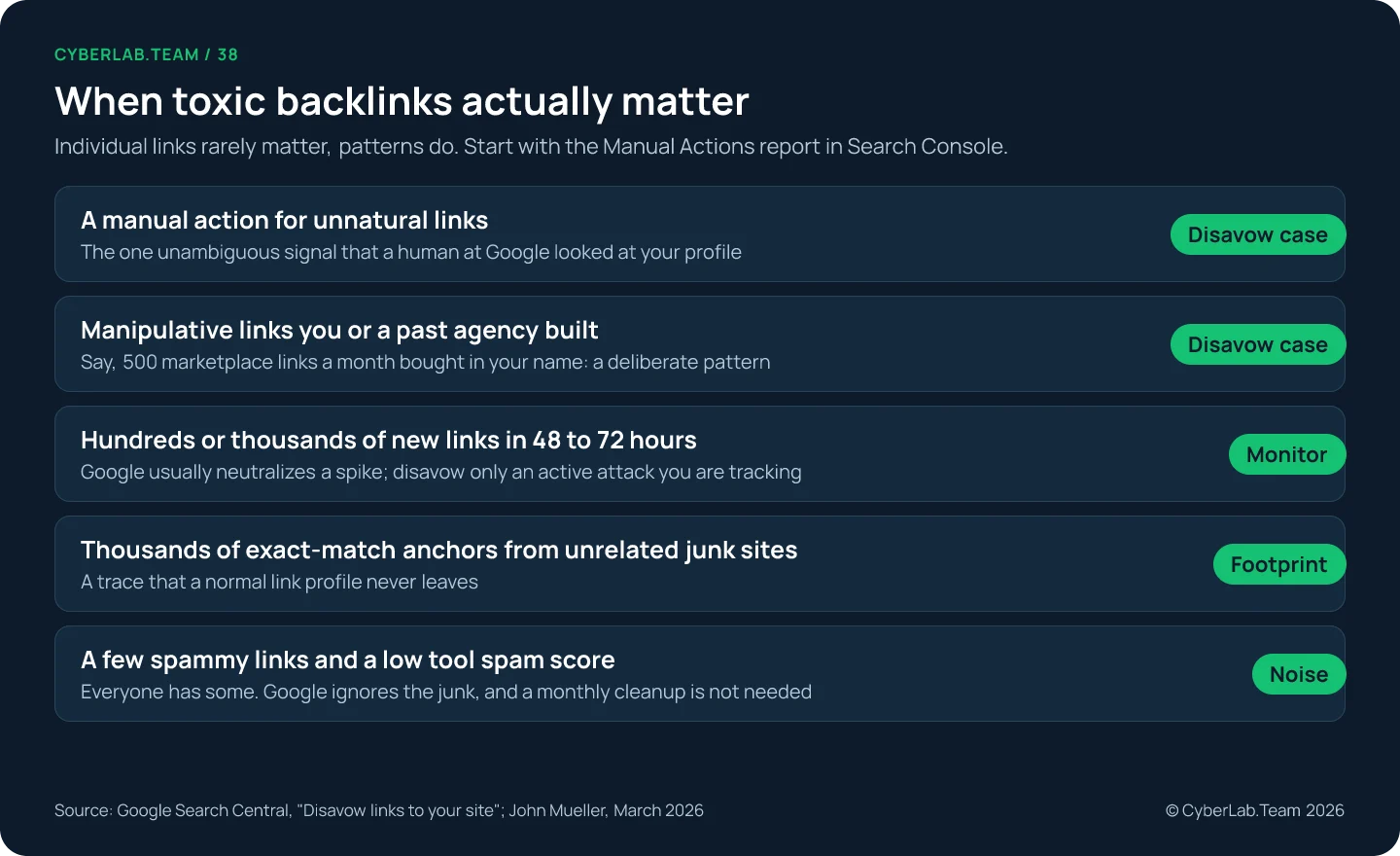
A useful rule: individual links rarely matter, patterns do. It starts to matter when one of these is true. The first two are cases for the disavow tool; the other two are reasons to look closer.
- You have a manual action. Open Search Console and check the Manual Actions report. A notice for unnatural links is the one unambiguous signal that a human at Google looked at your profile and did not like it. This is the case the disavow tool was built for.
- You, or a past agency, actually built manipulative links. If someone bought 500 marketplace links a month in your name, that is a deliberate pattern, not background noise.
- You are watching a real spike. Hundreds or thousands of new links landing in 48 to 72 hours is worth monitoring, even though Google usually neutralizes it.
- Scaled exact-match anchors. Thousands of “cheap dentist Warszawa” anchors from unrelated junk sites form a footprint that a normal profile never would.
If none of those describe you, you are in the ordinary category: everyone has a few bad links, and yours are noise.
The disavow tool: still here in 2026, still easy to misuse
The disavow tool is alive. In a March 2026 post on Bluesky, reported by Search Engine Roundtable, John Mueller confirmed that the domain: line in a disavow file can cover a whole top-level domain, which he called a big hammer for a concentrated spam problem. Google has also said the tool will go at some point. Bing removed its version in October 2023, and Google’s Gary Illyes has said that if the decision were his he would remove it too, because more people hurt themselves with it than are helped by it.
That last point is the real risk for a small business. A disavow file is a loaded tool. Disavow a domain that was sending you decent links and you throw away real value with no way to know you did it. Mueller’s own summary was that the disavow file is a tool, not a religion: most sites don’t need it, but that’s not all sites. In plain terms: if an agency wants to put you on a monthly disavow retainer and you have never bought a link in your life, you are paying for a chore that changes nothing.
What a small business should actually do
A short, calm routine beats a monthly panic. Two minutes in Search Console tells you whether a manual action exists, an occasional look at your link report tells you whether anything abnormal is happening, and the disavow file stays closed unless one of the cases above applies. The rest of your effort belongs on links you actually earn.
- Check for a manual action. Search Console, Manual Actions report, two minutes. If it is clean, you almost certainly have nothing to fix.
- Glance at your Links report a few times a year. You are looking for something wildly abnormal, like a five-figure jump in referring domains you cannot explain. Not for a low “spam score” number a tool invented.
- Only reach for disavow where the cases above call for it: a manual action, links you or an agency built (scaled exact-match anchors usually belong here), or an active attack you are tracking. Even then, disavow at the domain level, keep the file conservative, and remove nothing you are unsure about.
- Spend the saved energy on links that count. A few genuine mentions and links from sites your audience already trusts do more than any cleanup ever will.
If you genuinely cannot tell whether your link profile is a problem or just normal internet sediment, send us the Links report export from Search Console and tell us whether a past agency ever built links for you. That is the question a one-time site audit answers, without signing you up for a recurring cleanup you do not need.
Where this leaves you
Toxic backlinks are a real category and rarely a daily worry. For normal sites Google ignores most of the junk, and for manipulative ones it acts on patterns. The leaked field names show the machinery exists; they do not show that your specific links are hurting you. Check Manual Actions first, and be wary of any cleanup quote that skips that step.
Sources
- Charles Floate, “Toxic Backlinks,” PressWhizz, 26 May 2026: presswhizz.com/blog/toxic-backlinks
- Google Search Help, “Disavow links to your site.” https://support.google.com/webmasters/answer/2648487
- Search Engine Roundtable, “Google explains undocumented way to disavow entire TLDs” (John Mueller, March 2026). https://www.seroundtable.com/google-disavow-tld-41061.html
- Search Engine Roundtable, “Google Says Most Sites Don’t Need To Disavow Links But That’s Not All Sites” (John Mueller). https://www.seroundtable.com/google-disavow-advice-41042.html
- Search Engine Roundtable, “Google Will Remove Its Disavow Link Tool At Some Point.” https://www.seroundtable.com/google-will-remove-its-disavow-link-tool-37336.html
- Search Engine Roundtable, “Google Says Disavow Tool Hurts Too Many Sites” (Gary Illyes). https://www.seroundtable.com/google-disavow-tool-hurts-too-many-sites-28367.html
- Bing Webmaster Blog, “Bing Webmaster Tools to Remove Disavow Links Feature in October 2023.” https://blogs.bing.com/webmaster/september-2023/Bing-Webmaster-Tools-to-Remove-Disavow-Links-Feature-in-October-2023
- Search Engine Land, “How SEO moves forward with the Google Content Warehouse API leak” (the May 2024 leak). https://searchengineland.com/how-seo-moves-forward-google-leak-442749
- Search Engine Land, “Google updates Penguin, says it now runs in real time within the core search algorithm” (Penguin 4.0, 2016). https://searchengineland.com/google-updates-penguin-says-now-real-time-part-core-algorithm-259302