

Google Ads is worth it when a click costs you less than it earns you, and a waste when it does not. You only find out which by measuring. Every number in that sum, the price of a click, the share of visitors who buy, the value of a customer, changes with the country, the niche and the business, so an average from someone else’s account says little about yours.
This guide shows how to do the sum before you spend, where the published averages come from and what they leave out, when we would tell a small business to wait, and a test plan that gives a clear answer on a fixed budget. Every figure has a named source, listed at the end.
When Google Ads pays back, and when it does not
Google Ads tends to pay back when four things hold at once: people already search for what you sell, the profit from one sale covers the clicks it takes to win it, you can see which clicks became customers, and the budget buys enough clicks to learn from. When one is missing, the account usually loses money.
The first condition is the easiest to check. Google’s Keyword Planner shows how often people search for your terms and roughly what it takes to reach the top of the page, although it asks for billing details before it shows keyword ideas. Google warns on the same page that results depend on your bid, budget, ad quality, location targeting and customer behavior in your industry, so read its forecasts as a range. For the rest, Google’s pricing page gives the right starting point: set your bid based on what a click is worth to you.
Staying out is also a normal choice. Eurostat counted 32.6% of EU enterprises paying for internet advertising in 2024, from 60.4% in Malta down to 23.2% in Poland and 22.8% in Romania.
What a click costs, and why nobody can quote it in advance
There is no price list for Google Ads clicks. Each search starts a live auction, and you pay roughly what it takes to beat the advertiser ranked just below you. That amount moves with your bid, the quality of your ad and landing page, the competition in your area and the moment of the search.
Google’s page on Ad Rank lists the inputs: your bid, the quality of your ads and landing page, minimum thresholds, the competitiveness of the auction, the context of the search and the expected impact of your ad assets. Per the page on actual cost per click, you pay just enough to beat the Ad Rank below yours, and Google adds that higher quality ads can often lead to lower costs per click. The 1 to 10 Quality Score in your account is a diagnostic, and Google states that it is not an input in the auction.
Published averages give a sense of scale. The LocaliQ 2026 search advertising benchmarks, built with WordStream from its customers’ Google Ads and Microsoft Ads campaigns, put the average click at $5.42: $1.63 in arts and entertainment, $2.05 for restaurants, $8.00 for dentists, $8.33 for home improvement and $9.87 for lawyers. The figures are in US dollars, with no country breakdown.
Local prices can differ a lot. Polish specialist Artur Smolicki reports search clicks between 0.38 and 19.40 zł net in the Polish accounts he audits, with a median of about 2.17 zł; law firms and finance sit at the top, fashion and home goods at the bottom. It is one practitioner’s view with no published sample size, and still closer to a Warsaw business than a US average.
Two details change the real cost in Europe. Google adds jurisdiction-specific surcharges in some countries: 5% in Austria, 3% in Spain, 2.5% in Italy, 2% in France and the UK. Poland and Estonia were not on the list when we read it on 29 September 2026. And a daily budget is an average: per Google’s page on overdelivery, a campaign can spend up to twice it on a given day and no more than 30.4 times it in a month.
Prices also drift upward. LocaliQ reports a rise in the average click over the past year. In the US antitrust trial, Google executive Jerry Dischler testified in 2023 that Google tuned its auctions in ways that raised prices by up to 5%, sometimes more, without telling advertisers, as Search Engine Journal reported. In August 2024 the court found that Google’s monopoly power let it charge supracompetitive prices for search text ads, per Covington & Burling. A plan that only works at today’s click price is too tight.
How to work out your break-even cost per click
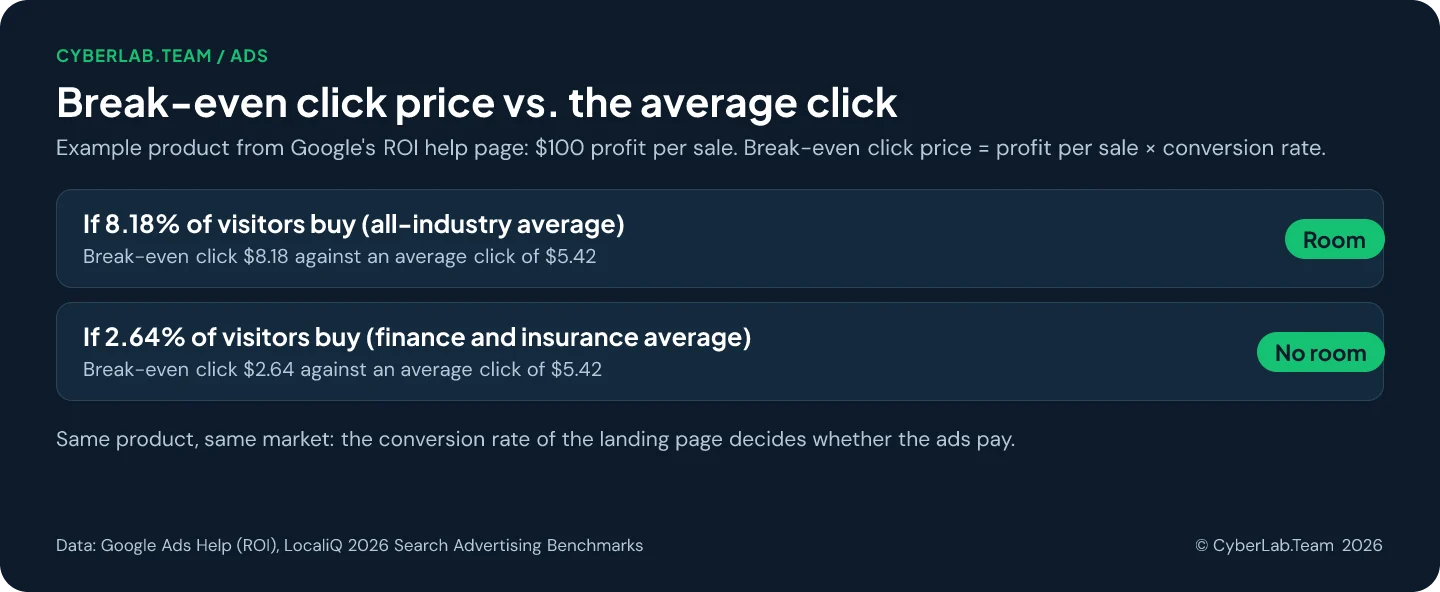
Your break-even cost per click equals the profit one sale leaves before advertising, multiplied by your conversion rate. Below that price per click the ads make money; above it every sale they bring loses some. With this one figure, “are Google Ads worth it” becomes a comparison you can check against real bids.
Take the product in Google’s own ROI example: it costs $100 to make and sells for $200, leaving $100 per sale. If 8.18% of visitors buy, the LocaliQ all-industry average for 2026, you can pay up to about $8.18 a click ($100 × 0.0818) and break even. That is above the $5.42 average click, so there is room. If 2.64% buy, the LocaliQ average for finance and insurance, the ceiling falls to $2.64, well under the average click. With the same product in the same market, the landing page’s conversion rate decides whether the ads pay.
If you sell through enquiries, add one step. The cost of a customer is the cost per lead divided by the share of leads you close. LocaliQ puts the average cost per lead at $66.69 in 2026, from $29.96 in automotive repair to $131.63 for lawyers. Close half your leads and each customer costs twice the lead price.
Three more inputs keep the sum honest:
- Lifetime value. A dentist, an accountant or a hair salon earns from a client for years, so the first visit understates what a new client is worth. Google Ads can bid higher for new customers than for existing ones, though that needs a purchase conversion goal and value-based bidding. Use the lifetime profit your books show, not the one you hope for.
- Sales cycle. Google counts conversions within a conversion window that defaults to 30 days and can reach 90 for Search, depending on the conversion source. If customers take months to decide, early reports understate results. When the sale closes by phone or in the office, offline conversion imports link it back to the click.
- Every other cost. Management fees, surcharges, returns and the time spent on enquiries come out of the same profit. In Google’s ROI example, $1,200 in sales against $600 in product costs and $200 in ads gives an ROI of 50%.
Will the ads bring customers you would have lost otherwise?
Some sales that follow an ad click would have happened anyway, through the free results or because the buyer already knew your name. What counts is the extra business the ads create. Studies of this reach different answers depending on who ran them and which keywords they tested, so it helps to know both sides.
Google’s side came first. In 2011 its statisticians ran more than 400 studies on paused campaigns and reported that on average 89% of ad clicks were incremental, not replaced by organic clicks once the ads stopped. A 2012 follow-up split this by organic position: when the advertiser already held the top organic result, 50% of ad clicks were incremental; at positions 2 to 4, 82%; below position 4, 96%.
Independent experiments are harsher. Tom Blake, Chris Nosko and Steven Tadelis ran large field experiments at eBay, published in Econometrica in 2015. Ads on eBay’s brand keywords had no measurable short-term benefit. On other keywords, new and occasional customers responded, but frequent buyers who would have purchased anyway absorbed most of the spend, and the average return was negative.
A third study matters for smaller brands. Andrey Simonov, Chris Nosko and Justin Rao tested brand searches on Bing across thousands of brands (Marketing Science, 2018). With no competitors bidding, brand ads had a positive effect of only 1% to 4%. Where competitors bid on a brand’s name and the brand did not advertise, they took 18% to 42% of its clicks, and defensive brand ads came out strongly profitable.
You will also see Google’s claim that businesses earn $8 in profit for every $1 spent on Google Ads. Its methodology combines a $2 return per ad dollar from Hal Varian’s 2009 research, five organic clicks per ad click, and organic clicks valued at 70% of an ad click. PPC Land notes that these assumptions have not changed materially across four reports. It models the whole economy and says nothing about your account.
In practice: report brand and non-brand campaigns separately. If you already rank first organically for a term, the ads on it are the first candidates for a pause test. If competitors bid on your name, keep a brand campaign.
When Google Ads is a bad idea
Google Ads usually loses money when results cannot be measured, when the margin leaves no room for the price of clicks, when a small budget is split across many campaigns, or when the click lands on a page that cannot turn a visitor into an enquiry. All of these can be fixed, and fixing them before launch costs less.
- No conversion tracking. Conversion measurement is how the account learns what a result is: a purchase, a form, a call. Smart Bidding sets bids in every auction to win those conversions, so without them it works blind. In the EEA, Google’s EU user consent policy requires valid consent, and measurement and remarketing need consent signals sent to Google. In basic consent mode nothing reaches Google when a visitor declines, so reports show fewer conversions than happened. Enhanced conversions recover part of the gap with hashed first-party data.
- Thin margins. If your break-even click price is below what clicks in your niche cost, better ad copy rarely closes the gap. Fix the price, the offer or the conversion rate first.
- A small budget spread thin. Google requires at least 15 conversions in 30 days for Target ROAS on Search and recommends judging Target CPA over periods with at least 30 conversions. At the LocaliQ averages, 15 conversions take about 183 clicks, roughly $994 a month; 30 take about 367 clicks, roughly $1,988. Split across five campaigns, none of them learns. Each change also triggers a learning period, typically one to two conversion cycles.
- No page built for the ad. Google rates landing page experience by how relevant and useful the page is to the person who clicked, and it feeds into ad quality and so into price. For scale, Unbounce found a median conversion rate of about 6.6% across 41,000 landing pages in Q4 2024.
- Defaults left on. Broad match is the default for every keyword and can match searches without your keyword’s direct meaning. The broad location option, “Presence or interest”, reaches people interested in your area as well as those in it; Google’s location targeting page suggests “Presence” when you only want people who are there. The search terms report shows what people typed, and negative keywords exclude searches you do not want to pay for.
How to test Google Ads without burning the budget
Treat the first months as a paid experiment with one question, a spending cap and a decision date. Work out the figures on paper, get measurement running, launch one narrow Search campaign, give it time to learn, then compare what a customer really cost with your break-even price.
Step 1. Do the math before you open the account
Write down profit per sale, expected conversion rate and, for leads, your close rate, then calculate break-even cost per click. Check bids for your main keywords in Keyword Planner for your own country and city. If typical bids already exceed your break-even price, stop: you have your answer for free.
Step 2. Set up measurement first
Before the first ad runs, make sure every enquiry is counted: purchases, forms, calls from ads and calls from the website, all of which Google supports as conversion types. In the EU, check that your consent banner sends consent signals to Google. If sales close offline, plan the CRM import now.
Step 3. Start with one Search campaign on high-intent keywords
Pick a small set of keywords where the searcher clearly wants to buy or book, such as your service plus a place. Limit the location to where you work, add obvious negatives on day one, and send clicks to a page that answers that exact search. Put brand keywords in a separate campaign so their cheap conversions do not flatter the rest.
Step 4. Give it enough clicks and time
Set the budget from Step 1 so it buys enough clicks for a readable number of conversions, and fix the length in advance, at least one full conversion window. Change little in that time, since changes to the bid strategy restart learning. Read the search terms report weekly and add negatives.
Step 5. Judge on profit, then check what the ads added
At the end, compare cost per customer with your break-even figure, fees and surcharges included. If you rank well organically for your main terms, test what the ads add: Google Ads custom experiments split traffic between the original campaign and a variant, or you can pause for a set period and compare. A test showing that Google Ads does not pay for your business is a useful result too.
What the averages will not tell you
Benchmarks describe other businesses’ accounts, mostly in other markets, and they shift every year. They help you check that your own figures are plausible; as forecasts they are weak. What a click costs in Tallinn, Warsaw or Lyon, and how well your own page converts, only your own test will show.
The LocaliQ figures come from its own customers, in US dollars, with no country split. Smolicki’s Polish ranges are one specialist’s view of the accounts he audits. The Unbounce median mixes every industry in its dataset and gives no figure for Google Ads traffic alone. Google’s incrementality studies and the $8 figure come from Google; the eBay study covers one very large, well known brand; the Bing study measured brand searches only.
If you already run Google Ads and cannot tell whether they pay, a one-time Ads Audit reads the account against its own data. If you are starting and want the test above set up properly, that is what our Google Ads management covers.
Sources
- Google Ads Help, About Ad Rank, read 29 September 2026
- Google Ads Help, Actual cost-per-click (CPC): Definition
- Google Ads Help, About Quality Score for Search campaigns
- Google Ads Help, Landing page experience: Definition
- Google Ads Help, Use Keyword Planner
- Google Ads, Pricing
- Google Ads Help, About overdelivery and your average daily budget
- Google Ads Help, Jurisdiction-specific surcharges, read 29 September 2026
- Google Ads Help, Return on investment (ROI)
- Google Ads Help, About customer lifecycle goals
- Google Ads Help, About conversion windows
- Google Ads Help, About offline conversion imports
- Google Ads Help, About conversion measurement
- Google Ads Help, About Smart Bidding
- Google Ads Help, About Target ROAS bidding
- Google Ads Help, About Target CPA bidding
- Google Ads Help, Duration of the learning period for campaigns
- Google, EU user consent policy
- Google Ads Help, Updates to consent mode for traffic in the European Economic Area
- Google Ads Help, About consent mode
- Google Ads Help, About enhanced conversions
- Google Ads Help, About keyword matching options
- Google Ads Help, Target ads to geographic locations
- Google Ads Help, About the search terms report
- Google Ads Help, About negative keywords
- Google Ads Help, Set up a custom experiment
- Google Economic Impact, Methodology
- Google Research, Studies show search ads drive 89% incremental traffic, 21 July 2011
- Google Research, Impact of organic ranking on ad click incrementality, 27 March 2012
- Blake, Nosko and Tadelis, Consumer Heterogeneity and Paid Search Effectiveness: A Large Scale Field Experiment, NBER working paper 2014, Econometrica 83(1), 2015
- Simonov, Nosko and Rao, Competition and Crowd-Out for Brand Keywords in Sponsored Search, Marketing Science 37(2), 2018
- LocaliQ, Stephanie Heitman, 2026 Search Advertising Benchmarks, updated 1 June 2026
- Unbounce, Average landing page conversion rate (Q4 2024 data)
- Artur Smolicki, Stawki CPC w Polsce, 27 September 2026
- Eurostat, A third of EU enterprises advertise online, 14 August 2025
- Search Engine Journal, Matt G. Southern, Google allegedly adjusts ad auctions to meet revenue goals, 19 September 2023
- Covington & Burling, D.C. District Court finds Google monopolized markets for online search and search text advertising, 9 August 2024
- PPC Land, Luis Rijo, Google’s 2025 U.S. economic impact report: $947 billion and what it hides, 5 May 2026