


Google Business Profile has a new tab called Collected info. It lists what Google’s automated assistant learned about a business in phone calls, text messages and WhatsApp chats, with the source and date of each item and a Delete link beside it. Google announced it on 14 September 2026, though the Help Center section describing it was already live in June.
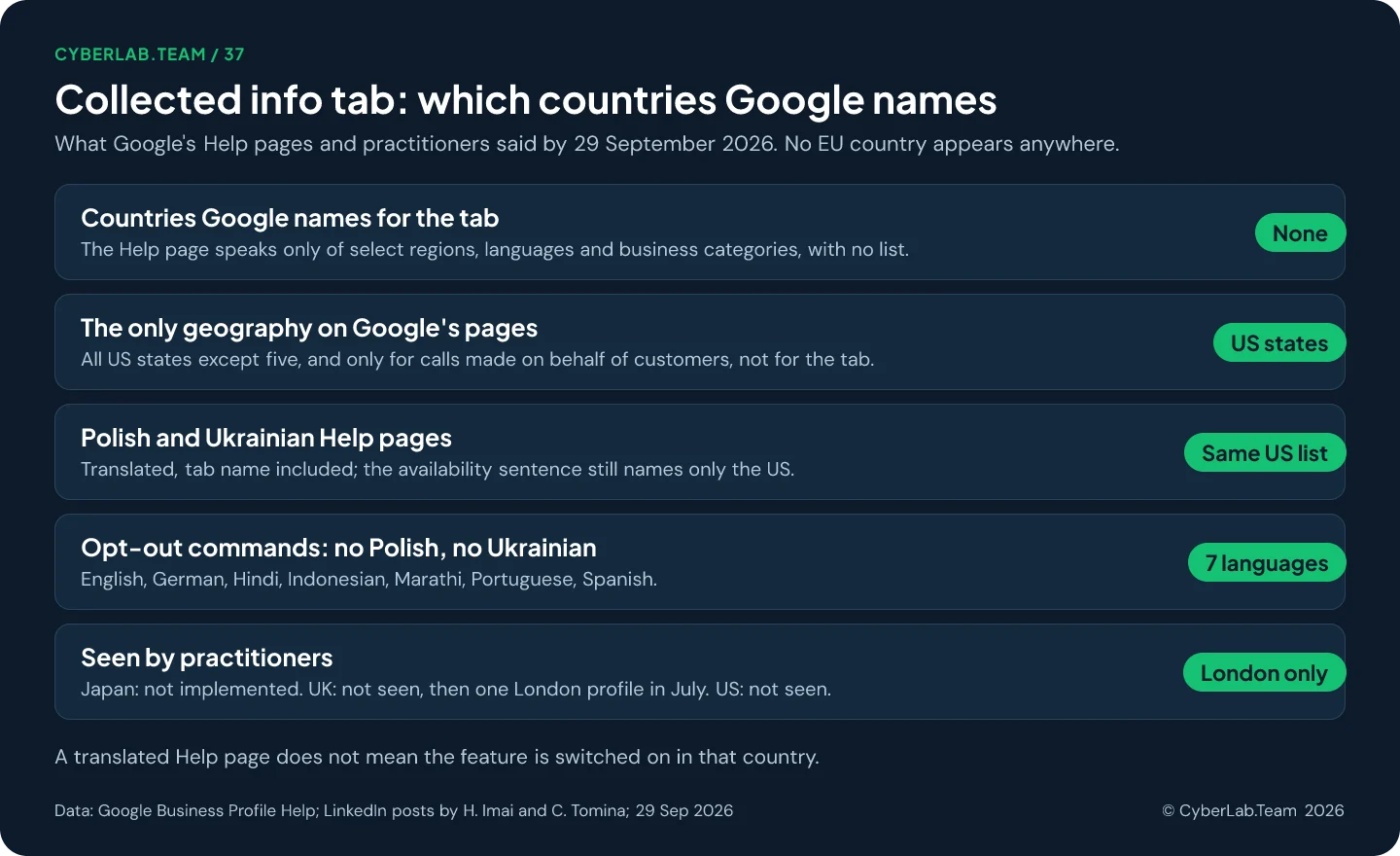
If your business is in Poland, Ukraine or elsewhere in the EU, you may not have the tab. Google says it is “available for select regions, languages, and business categories” without naming any EU country, and we found no report of the tab on a Polish or Ukrainian profile. The calls that feed it, and the limits of its Delete button, are still worth understanding.
Does the Collected info tab work in Poland, Ukraine or the EU?
Google does not say. Its Help page limits the feature to regions, languages and business categories it never names, and the only geography in these Help pages is a list of US states on a related page. Practitioners in Japan, the UK and the US reported not seeing the tab; one screenshot shows it on a London profile.
The states appear on the page about automated calls and texts from Google: “In the US, the feature is available in all states except Indiana, Louisiana, Minnesota, Montana, and Nebraska.” It covers calls made for customers, such as bookings, so it does not strictly describe the tab. The Polish version repeats the same American list, and the opt-out commands for text and WhatsApp messages are listed in seven languages, none of them Polish or Ukrainian.
In June, Hiroko Imai, a Product Expert, wrote that in Japan “it has not yet been implemented”; Claire Carlile replied that she did not see it in the UK. Around 10 July, Claudia Tomina posted the only live screenshot we found, from a London business, which contradicts the vendor GMBapi and its “currently available only in the United States”. London is not in the EU.
Such calls have crossed borders before: Google began updating listings by phone in the US in 2019, tested them in New Zealand that year, and in 2020 extended them to eight unnamed countries.
What the tab shows and where the data comes from
It is a log of facts Google gathered by contacting the business itself: closing times, seating, payment methods, wheelchair access. Each entry shows how and when it was collected, in the language it was given in, and can be deleted on its own. Google says it uses the data to match the business with customers’ searches.
The path is Edit profile, then Collected info. The interface text, quoted by Search Engine Roundtable, says the information “was collected in phone or chat conversations with your business.” Tomina’s screenshot has two blocks, “Confirmed in a phone call” and “Confirmed in a WhatsApp chat”, with short facts such as the Tuesday closing time and a Delete link on each. We describe it instead of showing it, since it is her image of another firm’s profile.
Google “may occasionally reach out using automated messages via call, text, or WhatsApp” to the verified number, and “any information you provide in response to these messages may be used to update your profile.” An email Google sent owners in March, reproduced by Search Engine Roundtable, went further: such information, “including photos and posts, will be added to your profile on your behalf when applicable.” Changes from calls stay “Pending” for a review that “might take up to 5 business days”, and Google can publish posts on your behalf from your answers, emailing you each time.
What Delete does, and what Google has not said
Delete takes one item out of what Google calls “Google’s records”. Google says it “does not change other details” on the profile, and practitioners read that as no undo for an hour already published. Google has not said whether it reaches call recordings, other Google systems or its assistant’s answers, so its wider reach is undocumented.
The Help page says deleting “removes it from Google’s records but does not change other details already on your Business Profile.” Google’s forum post, as relayed, says it removes the item “from Google Search and Maps”. Neither wording mentions the assistant. Google has not addressed whether a deleted item also leaves the index and the assistant’s answers; that is our open question.
Ali Farhat adds that the speed at which deletions affect future updates is not established, and there is no documented API or retention control. GMBapi calls the tab “an audit trail, not a rollback button.” If a wrong hour is already public, correct the field itself (profile checklist). Blue text in the editor marks changes made by Google. A different rule covers edits suggested by users: when one needs your review you have four days to accept or reject it, after which Google may publish it if other public sources, such as your website, support it.
The GDPR questions this raises (our reading, not legal advice)
Most entries concern a legal person, such as a limited company, which GDPR does not cover. The person on the phone is different: their recorded voice and words, and a sole trader’s details, can be personal data. The Help pages and Privacy Policy we read name no legal basis for these calls, and Delete is not a GDPR erasure request.
In the GDPR, Recital 14 leaves out data about legal persons, while Article 4(1) covers any information about an identifiable natural person. Google’s sample script tells the business “this call is recorded to help improve Google services”. The Privacy Policy names Google LLC as controller for what is “displayed in services like Google Search and Google Maps regardless of your location” but never mentions calls to businesses.
The policy lists legitimate interests among its grounds, and Article 6(1)(f) is one basis that could fit, since consent is hard to collect on a cold call. Google already uses that balancing test when individuals ask to remove a local listing, and on that basis a person may object under Article 21. Article 14 requires telling a person whose data came from someone else where it came from; the tab’s source and date line does that for the owner. The employee who took the call gave the data directly, so Article 13 applies to them, and the notice they get on the call is the sentence the caller reads out.
Article 17 erasure reaches further: once data is public, the controller must take reasonable steps to inform others holding copies. Google does not claim the Delete button meets it. Rules on recording a call also come from national law, which in the EU implements the ePrivacy Directive. Its Article 5(1) protects the confidentiality of communications against third parties, and how national laws treat a caller recording its own call differs by country. Poland’s data protection authority (UODO) has said public offices mostly lack a legal basis to record calls, and added that such recording also captures the employees’ data, which it considers unlawful under labor law (EDPO summary). That was about public offices, yet it shows the regulator counts the person on the phone. We found no regulator statement on Duplex or this tab. The nearest EU guidance, the European Data Protection Board’s 2021 guidelines on virtual voice assistants, says providers of such assistants must consider both the GDPR and the ePrivacy Directive. It covers assistants people talk to, not one that calls a business, so it is only an analogy.
The person who answers the phone now edits the profile
Whoever picks up the verified number is, in practice, editing the profile. A new hire who guesses the closing time or mentions walk-ins can create an entry that Google treats as confirmed. A short routine for answering the phone now belongs to profile management, next to the fields you edit yourself.
Robert Farrell, co-owner of six bagel stores in Manhattan, wrote under Tomina’s post that whoever picks up “during a rush, possibly someone in week two, is now answering questions that edit our Business Profile.”
In the US, Google also calls businesses for searchers about prices, and Carrie Hill of Sterling Sky advises preparing staff to quote clearly. One routine covers both:
- Tell everyone who answers what to expect: in Google’s sample script the caller says it is from Google Maps, automated and recorded, and such calls come from designated numbers.
- Give them the current answers (hours, services, payments, accessibility) as they appear on the profile, and let them say “I’ll check” instead of guessing.
- Decide on the three switches under More, Business Profile settings, Advanced settings: customer bookings and inquiries, keeping the profile up to date, and posting on your behalf. Opting out requires a verified profile (setup guide), and Google may still call manually.
- After any change to hours or services, check the tab, the blue Google edits, the public profile and the profile’s figures in GA4.
Switches can revert. In 2019, when the product was still Google My Business, a Product Expert found her opt-outs on about 200 locations switched back on (only a few, she later said), and in 2024 a practitioner had to turn bookings off twice. In our monthly management, checking this tab alongside Google’s edits is now part of each pass wherever the tab exists.
Where practitioners disagree
Google argues for accuracy: asking the business directly keeps hours and details current and saves the owner work. Critics see listings changed without asking. The one measurement in the debate comes from Whitespark, which said in October 2025 that it saw no rise in Google’s automatic updates across the profiles it tracks.
In 2018 Google wrote that Duplex could call about opening hours and publish them, “reducing the number of such calls businesses receive” (Google Research). By October 2020 it counted over 3 million updates, seen over 20 billion times in Maps and Search.
Complaints are older than the tab. In 2018 a Local Search Forum member wrote that Google would “randomly change a location’s hours and publish it”; in October 2025 another poster said Duplex “keeps changing the business hours” on their listings, and in another thread a member called it “Google AI thinking it knows best.” There the Whitespark account, whose platform tracks more than 12,000 profiles, replied: “We are seeing no uptick in updates. The volume is about the same as always.” Its method was not published.
One of Imai’s commenters welcomed a reject button next to the old accept one. Among the sources we read, nobody objects to the tab itself; the criticism targets the calls and whoever happens to answer them.
Sources
Every fact above comes from the pages below, all accessed on 29 September 2026. Google’s Help pages show no publication date. We could not retrieve the Search Engine Land report of the announcement, so it is not used here.
- Google Business Profile Help, “Edit your Business Profile”, section “Review information collected by Google”
- Google Business Profile Help, “About automated calls and texts from Google to your business” and its Polish version
- Google Business Profile Help, “Manage advanced profile settings”
- Google Business Profile Help, “Help protect against fraudulent calls and texts”
- Google Business Profile Help, “Understand Google updates on your Business Profile”
- Google Local Listings Help, “European privacy requests: Local listing removals”
- Google Privacy Policy, effective 2 April 2026
- Google Business Profile on X, 14 September 2026
- Google, The Keyword, Duplex updates to business listings, 15 October 2020
- Google New Zealand, Duplex holiday-hours pilot, 21 October 2019
- Google Research, “Google Duplex: An AI System for Accomplishing Real-World Tasks Over the Phone”, 8 May 2018
- Google, AI-powered calling to local businesses in Search, 16 July 2025
- Search Engine Roundtable, “Google Business Profiles New Collected Info Actions”, 22 June 2026
- Search Engine Roundtable, “Google Business Profiles New Collected Info (Visuals)”, 13 July 2026, updated after 14 September
- Search Engine Roundtable, “Google Business Profiles May Call, Text or WhatsApp To Confirm Business Details”, 31 March 2026
- Hiroko Imai on LinkedIn, June 2026, with comments
- Claudia Tomina on LinkedIn, July 2026, the live screenshot and comments
- GMBapi, “Google’s New ‘Collected Info’ Tab: What Multi-Location Teams Need to Know”, July 2026
- Ali Farhat, DEV Community, 16 September 2026
- Sterling Sky, Carrie Hill, “Is Google’s AI Calling Your Business?”, 11 December 2025
- Local Search Forum, “Google Changes and Publishes Wrong Hours”, 2018
- Local Search Forum, “Google Assistant Calls: manually opt out”, 2019 to 2020
- Local Search Forum, “Should I turn off Google Assistant calls?”, 2024
- Local Search Forum, “Google Duplex AI Changing Hours”, 2025
- Local Search Forum, “Is anyone else seeing an increase in Google auto-updating business info?”, 2025
- Regulation (EU) 2016/679 (GDPR), EUR-Lex: Recital 14, Articles 4, 6, 13, 14, 17 and 21
- Directive 2002/58/EC (ePrivacy Directive), EUR-Lex: Article 5
- EDPO, “Nagrywanie rozmów telefonicznych przez urzędy”, the Polish data protection authority on recording phone calls in public offices, 1 February 2024
- European Data Protection Board, Guidelines 02/2021 on virtual voice assistants, version 2.0, adopted 7 July 2021