
Between 13 and 18 September, search and Google Ads specialists in Germany and the Netherlands noticed that free product carousels had gone from Google Search in the European Economic Area. In their place Google shows a unit of comparison sites, and often the only product images left are paid ads. SEO Südwest documented it on 13 September and Search Engine Roundtable on 18 September.
We read what Google and the European Commission have published, traced the headline numbers to whoever measured them, and ran our own check from Poland on 29 September.
What disappeared, and what Google has not said
In mid-September organic product carousels with offers from many shops vanished from the main results page for almost all commercial queries the tracker Productrise follows in Germany, France, Belgium, the Netherlands and Sweden. Free listings in Merchant Center still exist. What is missing is an official word: no Google page or Commission text we found announces or dates the removal.
Merchant Center Help still lists Maps, Gemini, YouTube, the Shopping tab, Images and Lens as places for free listings, and nothing we found in Google’s published help says those stopped in the EEA.
On 8 September Google published documentation on regional differences in Search, with EEA units for product queries. Neither those pages nor the Merchant Center change log, as we read them on 29 September, say the carousel was switched off. The one Google confirmation in circulation is secondhand: Barry Schwartz wrote that Ginny Marvin, Google’s Ads Liaison, “confirmed in a comment” that the listings went because of the DMA ruling. Her words are not in the public part of the LinkedIn thread, and Elsop wrote that it could not read the comment either. The removal rests on observation and press reports; in the Google pages we read on 29 September it is documented nowhere.
Why it happened: the DMA decision of 23 July
The trigger is a Digital Markets Act decision. On 23 July 2026 the European Commission found that Google Search favors its own services, shopping among them, over those of third parties, fined Alphabet EUR 460 million for Search and gave it 60 days to comply. The Commission’s release demands fair treatment of third-party services but prescribes no specific measure.
The decision applies Article 6(5), which bars a gatekeeper from treating its own services more favorably in ranking than similar third-party ones, and the press release warns of periodic penalties of up to 5 percent of worldwide turnover. The release gives no calendar deadline: PinMeTo counts to 21 September, while Adriaan Dekker, the Dutch Google Ads freelancer whose post Search Engine Roundtable quoted, wrote 25 September. Neither Article 6(5) nor the release names free listings, so removing them is Google’s choice of remedy. Google blames the DMA only in general terms, in statements by Kent Walker and by Nick Fox, relayed by Search Engine Journal; neither mentions product listings.
Google’s program for comparison shopping services, or CSS, grew out of the Commission’s 2017 Google Shopping decision, which the EU Court of Justice upheld in 2024, and Merchant Center Help already required a CSS for Shopping ads and free listings in Poland, Germany, France, Sweden, the Netherlands, Belgium and other countries. What changed in September is the layout of the results page.
What the 90 to 100 percent figure measures
It measures how often a format appears, not how much traffic shops lost. Productrise, a Dutch vendor of product rank tracking, counts the share of its tracked commercial queries that show an organic product carousel. In Germany, France, Belgium, the Netherlands and Sweden that share fell by roughly 90 to 100 percent within days.
Hugo Huijer, who founded Productrise, published the series on 17 September. Before the change, about 85 percent of the commercial queries it tracks triggered at least one carousel; the five EEA curves collapse around 15 and 16 September, while the UK, the US and Australia stay flat. The query list, sample per country and device mix are unpublished, as the German trade outlet onlinemarktplatz.de pointed out. Schwartz saw the same shape in a Semrush chart but published no figure. Google also appeared to be blocking scrapers more successfully from around 13 September, so third-party tracker data from that week needs care; Productrise’s British, American and Australian series stayed flat in the same days, which makes a scraping artifact less likely.
The only shop-side figure comes from Label Up, a German feed and CSS provider: organic impressions and clicks in the Merchant Center accounts it manages fell by “gut 20 Prozent,” a good 20 percent, in the first days, with no account count, window or country split. From the other side, the CSS vendor Shoparize says clicks on CSS product pages “roughly tripled” across 21 EU markets, from internal data with no baseline. Both sell CSS services.
What we saw when we checked from Poland
On 29 September we ran nine product searches from a Polish IP address, with Google set to Germany, Poland and, as a control outside the EEA, Ukraine. In the German and Polish settings the Shopping tab was missing and no free product block appeared. Opened by direct address, the Shopping vertical still worked in both countries.
We searched signed out, cookies rejected, personalization off, between 11:05 and 11:09 Central European Summer Time, setting the country with Google’s gl and hl parameters: four German queries, three Polish, two Ukrainian. Both Ukrainian pages had a Shopping tab; none of the seven EEA pages did. Each Polish search showed a “Produkty sponsorowane” (sponsored products) block, and in the one for men’s running shoes every card named its comparison service, such as Google, Kelkoo, Klarna, Sembot or Channable. In four EEA searches Google Shopping itself appeared as an ordinary organic result, like any comparison site. Adding udm=28 to the address, a trick Productrise credits to Paul Schreiner, opened a full grid of offers in both Poland and Germany. With the tab gone, the only ways into the vertical we saw were that address and Google Shopping’s own organic result.
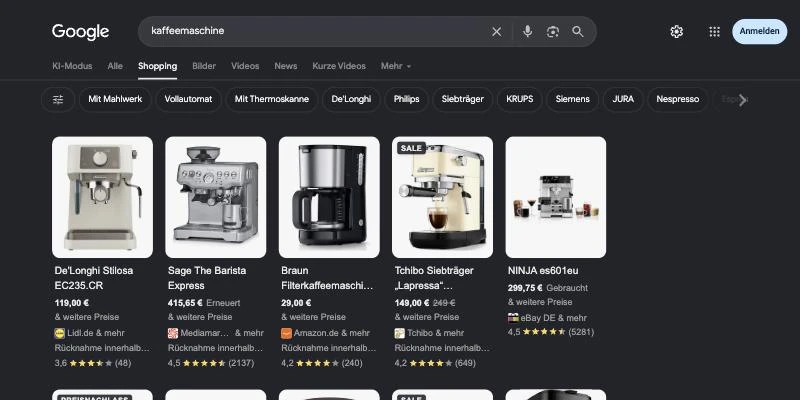
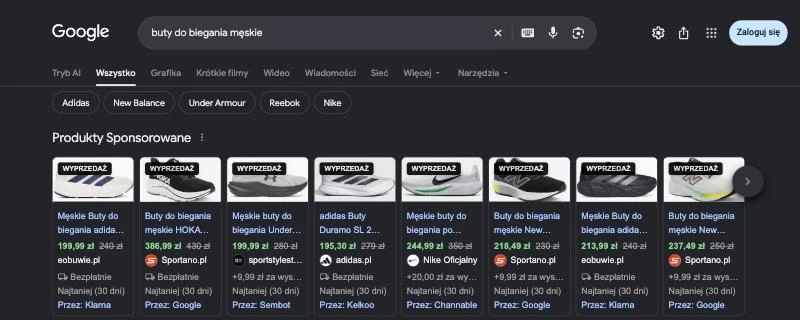
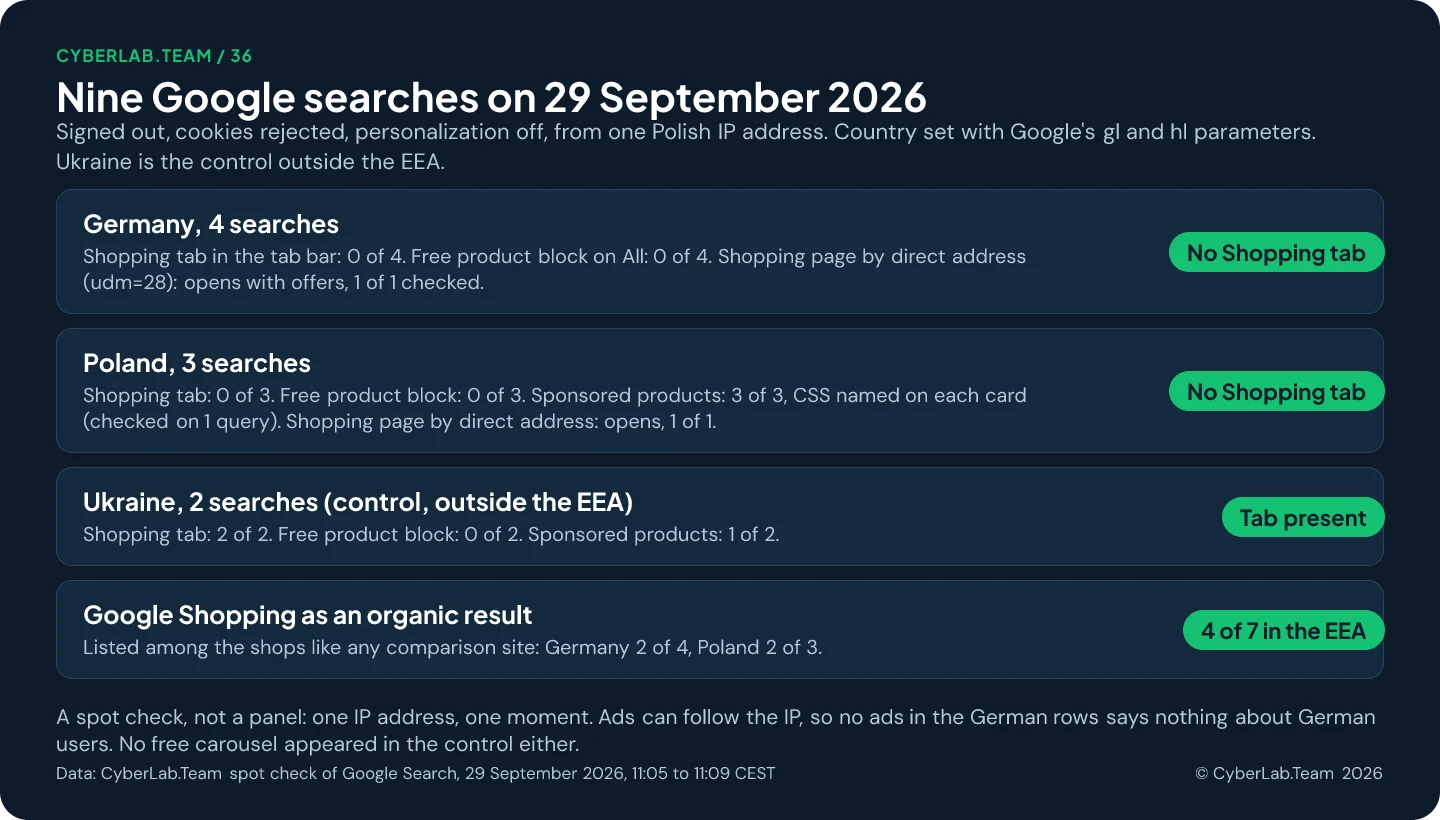
This is one IP address at one moment. German settings are not a German connection: ads can follow the IP, and the paid products in our Ukrainian control came from Polish shops, so seeing no ads in the German rows says nothing about what Germans see. We saw no free carousel in the Ukrainian results either, so the only contrast our check can show is the Shopping tab. It supports no percentage. None of the published series includes Poland either: Productrise’s five countries leave it out and Label Up does not split its accounts by country, so these three Polish searches are the only Polish data we have.
Who loses the most
Practitioners in Germany expect small and medium shops to lose the most: those for whom the free carousel was the only free place on the main results page and who never bought Shopping ads. Nobody has measured it yet. Comparison services get the new space on the page, though a coalition of them warns about the shape of the remedy.
Christian Kunz of SEO Südwest and the agency krick.com both expect smaller shops to struggle, though neither has data yet. PPC Land summed up such a retailer’s options: buy Shopping ads, work through a CSS that takes a margin, or accept the loss. In a letter of 8 September, twelve European CSS firms warned the Commission that a closed product box run by Google would push merchants back to Google’s own CSS. The letter concerns the paid unit, and their claim of 74 percent of third-party CSS clicks is their own estimate, with no method.
What a shop in the EEA can do now
Keep the Merchant Center feed and the product markup, find out which CSS carries your free listings, and measure the damage before moving money. The feed still serves paid Shopping and other Google surfaces, markup feeds the new EEA formats, and one agency’s early estimate is too thin to base a budget on.
Today, leave the feed on, as onlinemarktplatz.de also advised. In GA4, free-listing traffic appears as “Shopping free listings” in the source platform dimension. Elsop suggests splitting it into EEA and other countries and marking 15, 16 and 18 September, which gives you the loss figure no public source has.
This week, look at your product pages. The supplier unit that Google shows beside the comparison unit is filled from crawling, as long as your site serves users in the EEA. A structured data carousel, still in beta, covers EEA product queries and reads Product and ItemList markup on your own pages. Neither guarantees a place, and both reward the basics of ecommerce SEO: indexable product pages, valid markup, current prices.
Then open the CSS dashboard in Merchant Center. Free listings in Europe run through the one CSS you select there, and Google Shopping is itself one of the CSSs. Only approved comparison services get a row in the comparison unit; a shop cannot apply for one itself. For ads, the entry plans published on 29 September ran from a free CSS at Bidnamic, a Google Ads management agency, to EUR 29 per month per Merchant Center account at Producthero (its Pro plan is EUR 99) and EUR 27 at Shoparize, whose page leaves unclear whether that is the annual or monthly rate. Vendors say a partner CSS avoids a 20 percent margin Google Shopping takes from each bid; Google’s own help says only “a fixed percentage margin.” None of these fees buys back the free carousel. They lower the cost of ads.
If GA4 shows that free listings brought real orders, test a small Shopping campaign through a partner CSS, sized against the lost clicks and your margin, before moving a whole budget; our advertising hub covers the paid side. Then watch whether the Commission accepts the new layout, whether carousels return in another form, and what Label Up reports once it has four weeks of data.
Why we are not writing “gone for good”
Nothing official says the change is final, and Google has reversed an EEA change before: in late 2024 it pulled hotel features for users in Germany, Belgium and Estonia as a DMA test, then stopped the test, citing negative impacts. The Commission had not said by late September whether the new layout complies.
Google announced that test in November 2024 and ended it in December. Huijer calls his figures a snapshot and counts a comeback in another form among the possible outcomes, and the German merchants’ news service Händlerbund calls the question open.
On 29 September the free carousel was missing from the main results in every EEA setting we checked, as it had been for the observers we cite since 13 September. Every figure about the damage so far comes from a vendor with a stake in the answer, and our own check covers one morning from one IP address.
Sources
- European Commission, Commission fines Google EUR 890 million for breaches of the Digital Markets Act, IP/26/1670, 23 July 2026
- Regulation (EU) 2022/1925, Digital Markets Act, Article 6(5)
- European Commission, Google Shopping decision, IP/17/1784, 27 June 2017
- Court of Justice of the EU, press release 135/24, Google Shopping (C-48/22 P), 10 September 2024
- Google Search Central, Regional differences in Search experience, updated 18 September 2026
- Google Search Central, Aggregator unit and Supplier unit
- Google Search Central, Structured data carousels (beta)
- Google Search Central, Documentation updates
- Merchant Center Help, Free listings for products
- Merchant Center Help, Working with Comparison Shopping Services and About advertising with Comparison Shopping Services
- Merchant Center announcements, read 29 September 2026
- Google, Kent Walker, statement on the Commission’s Search and Play DMA decision, 23 July 2026
- Google, An update on our compliance with the DMA, 26 November 2024
- Google, Sharing data on our DMA hotels test, 12 December 2024
- Search Engine Journal, Google Rolls Out Redesigned Search Results Across The EEA, September 2026
- Search Engine Roundtable, Barry Schwartz, Google Search Drops Free Product Listings From the EEA, 18 September 2026
- Search Engine Roundtable, Google May Be More Successful In Blocking Scrapers & Tracking Tools, 18 September 2026
- Adriaan Dekker, LinkedIn post and comments and blog copy, September 2026
- Productrise, Hugo Huijer, Google’s product carousels are disappearing from search in the EEA, 17 September 2026
- Productrise, Hugo Huijer, The EEA lost its product carousels. Shoppers still have Google Shopping, 24 September 2026
- onlinemarktplatz.de, Google Produktkarussells brechen im EWR ein, 18 September 2026
- SEO Südwest, Christian Kunz, Google Shopping von Suchergebnissen fast komplett verschwunden, 13 September 2026
- krick.com, Google Shopping verschwindet aus der Suche, 14 September 2026
- Label Up, Google Shopping ist nicht verschwunden, September 2026
- Shoparize, The EU vs Google Shopping, 24 September 2026
- PPC Land, Google drops free shopping listings across Europe in two days, 19 September 2026
- PPC Land, Google shopping box would push 93,000 merchants back to Google, rivals warn, 13 September 2026
- PinMeTo, Google removes free product listings from EEA search, 21 September 2026
- Elsop, Google’s EEA Product Results Switch to Comparison Sites, 19 September 2026
- Händlerbund Online-Händler-News, Google baut Shopping-Suche in Europa um, 21 September 2026
- CSS price pages read on 29 September 2026: Producthero, Shoparize, Bidnamic
- Our own measurement: nine Google searches with German, Polish and Ukrainian settings from a Polish IP address, 29 September 2026, with screenshots