
“Best CRM software.” “Top help desk platform.” “The #1 tool for X.” For a couple of years, one of the cheapest ways to show up in AI answers was to publish your own “best [category]” listicle and rank your own brand at the top. Language models pulled these pages in as sources, and the brands behind them got cited. New analysis from Lily Ray, VP of SEO and AI Search at Amsive, suggests the tactic has started to work against the brands using it. In her framing, ranking yourself #1 in your own listicle can act as a vote for your competitors.
This article owns one question: the difference between being cited and being recommended in Google’s AI Overviews. How ChatGPT picks what to fetch is a different mechanism, covered in how ChatGPT picks sources.
The tactic, and why it worked
You write “The 7 Best Project Management Tools” and put your own product at number one, ahead of the real market leaders. Before AI search almost nobody did this, because openly biased content costs you trust with any human reader. AI answers created a gap: a content void around “what is the best tool for X,” and self-ranking pages rushed to fill it. Early models had no reliable way to tell self-promotion from genuine authority, so a page that said you were the best, in the right format, could get pulled in.
It got crowded fast. Ray reports finding 184 of these pages across 146 brands, and says the format went viral in 2025. Shopify, she notes, at one stage had more than 100 articles of this type and now appears to be culling many of them. When a tactic scales like that, search engines have a reason to react.
What Lily Ray measured
Ray tracked 100 B2B “best [category] software” queries in Google’s AI Overviews and pulled the answers and their exact sources on three dates between April and June 2026. About 1 in 5 queries returned no AI Overview. On the 80 that did, she separated two things: whether a brand’s own listicle was cited as a source, and whether that brand was recommended as a pick in the answer.
The gap between the two is the finding. When a brand’s own self-promotional listicle was cited, the brand was still left out of the recommendation 69% of the time, which is 224 of the 323 self-promotional listicles she counted. Across the full set, 74 of the 100 queries produced an answer that cited a self-promoter’s page and recommended someone else.
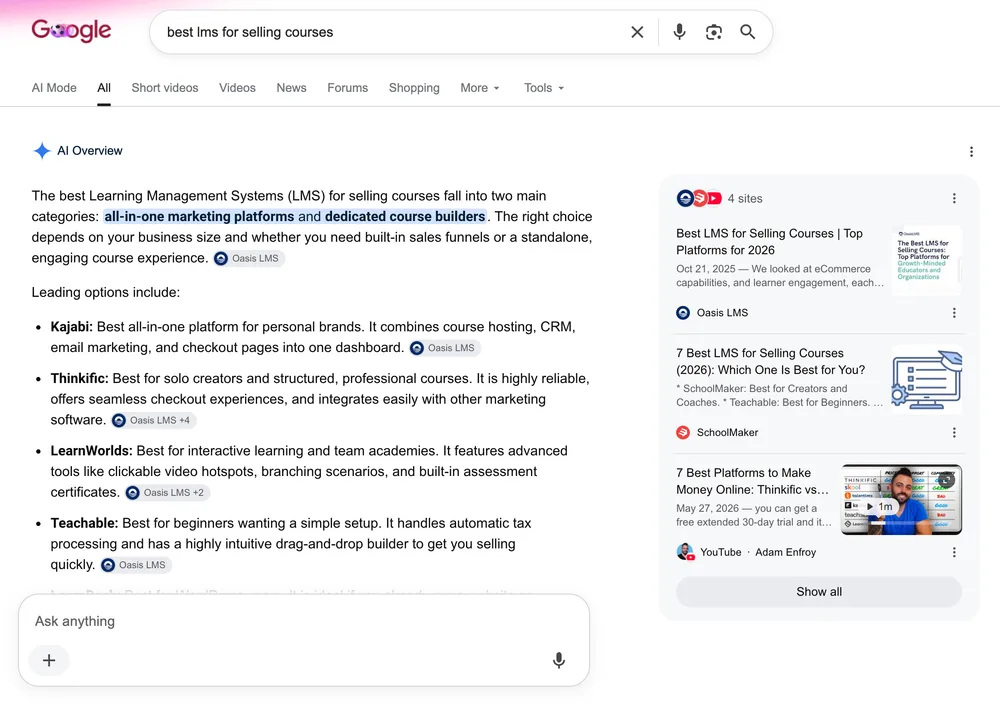
Her example: a learning platform ranked itself best “LMS for selling courses,” was cited, and the answer recommended Kajabi, Thinkific, LearnWorlds and Teachable. She shows the same split in help desk, task management and survey software, where one survey brand was cited from two of its own pages and still absent from the list of tools the answer suggested.
The limits apply to everything below. This is Ray’s analysis of US B2B software queries and of sites she chose, not a Google announcement, and Google has not published a mechanism.
A citation is not a recommendation
Ray argues the recommendation matters “by an order of magnitude,” and click behavior points the same way. Pew Research found in July 2025 that when a Google search showed an AI summary, users clicked a link inside that summary in just 1% of visits. If almost nobody clicks the sources, the brands the answer names as good options are what the reader acts on. Someone asking “what is the best help desk for a small team” usually remembers the two or three names in the answer. A self-serving listicle can earn a citation nobody clicks while the visible recommendation goes to the rivals listed underneath you.
Why the big brands still get away with it
Ray’s read is that the outcome depends on how authoritative the brand already is. A category leader can publish “we’re the best” and still be cited and recommended, because the rest of the web agrees. A smaller brand doing the same thing is cited and skipped.
She compares referring domains and mentions in AI Overviews and ChatGPT: the recommended brands sit far ahead of the cited-but-ignored ones on every signal. In CRM, the one self-ranking brand that also gets recommended is Monday, with a Domain Rating in the 90s and tens of thousands of referring domains, while challengers publishing the same kind of page trail on every metric, some with no AI Overview or ChatGPT mentions at all.
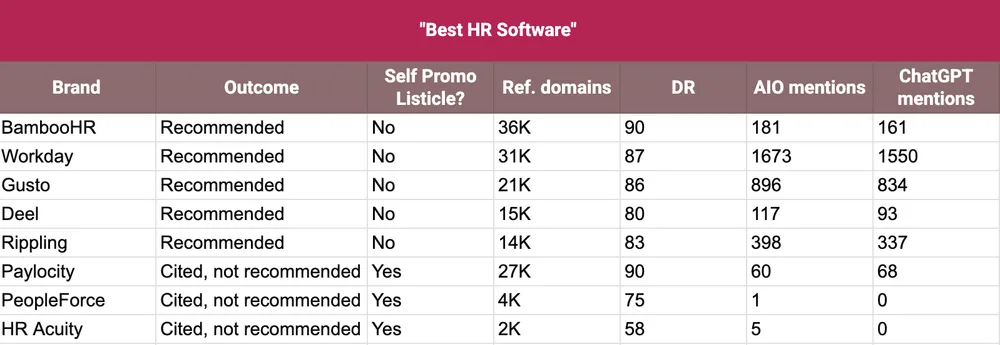
The lever that moves the answer, on this evidence, is the off-site footprint, not your own page.
It can also cost you in classic search
Ray also reports that around 20 January 2026, dozens of sites leaning hard on this tactic began losing organic traffic, and that the declines continued through Google’s May 2026 core update, often across the whole domain. The more than 40 sites she analyzed generally combined several spam-adjacent signals: scaled AI-generated content, mass-produced format pages, and hundreds or thousands of articles ranking their own brand first. The risk she describes is scale and stacking, not one comparison page.
What the AI leans on instead
For “best” queries, Ray’s citation data points at high-authority names. Forbes, Reddit and YouTube keep climbing as the sources AI Overviews lean on, with Reddit growing fast and Forbes Advisor surging since around March. Answers increasingly borrow their judgment from independent review sites and from places where people compare options in public. For some “best [x]” queries, Ray also shows an AI Overview disclaimer saying a category is “saturated with self-proclaimed experts,” and notes that Claude flags spammed categories in a similar way.
What Google itself says
In its guide to optimizing for AI features in Search, Google says that chasing mentions across the web in an artificial way is not a shortcut, and that manufactured or inauthentic placements are what its spam systems are built to catch. A wall of pages calling yourself the best is an artificial mention of yourself at scale. The self-ranking listicle worked for a while because the models had not caught up, not because Google endorsed it.
What we checked ourselves
On 2 October 2026 we ran four “best” searches from our own niche in ordinary Google, signed out, from Poland, and opened the lists at the top. We recorded the ordinary results only, without AI Overviews, so the check counts self-ranking pages and says nothing about how an AI answer treats them.
- “najlepsza agencja pozycjonowania lokalnego” (Polish for “best local SEO agency”): four of the five ranking pages we opened were written by an agency that puts itself at number one. They took four of the first seven ordinary results.
- “best Google Business Profile management agency”: four of the six pages we opened came from a software vendor ranking its own product first, Semrush among them. Most of the top answers to a query about an agency were lists of tools.
- “best GEO agency for AI search”: three of the four lists we opened were written by an agency that ranks itself first.
- “best local SEO agency Poland”, asked in English, was the exception. The top lists came from directories and marketplaces such as Clutch, Sortlist and The Manifest, and we saw no agency ranking itself.
Across the three searches where we opened pages, 11 of 15 put their own author first. One session from one place is a snapshot, and the order shifted between two loads of the same query. It does show that Ray’s pattern reaches our market, and that in Polish it fills the top of the results.
How to check your own exposure
You do not need a research budget. The method below is Ray’s, scaled down. Above is our own small run of it, without checking AI answers.
- Run your own “best [category]” queries in Google and in an assistant such as ChatGPT. Note which brands are named as picks.
- Look at the sources under the answer. If your page is cited but your brand is missing from the recommendation, you are in the split described above.
- Count your self-ranking pages. One comparison article is not the pattern Ray ties to domain-wide declines. Dozens or hundreds that all crown your own brand are.
- Compare your off-site footprint (independent sites that link to you or mention you) with the brands that do get recommended.
What earns the recommendation instead
What moves the recommendation is being talked about and linked to in places you do not control, which is what the authority tables above measure.
- Third-party mentions and roundups you did not write. Trade publications, independent reviewers, partners and journalists. Pitch reviewers, offer trials, and make it easy to evaluate you fairly.
- Real reviews on independent platforms, and useful participation in communities such as Reddit, where AI answers increasingly look. You cannot spam your way in.
- First-hand, specific content that answers real questions in your field, which Google says AI systems are built to surface.
That work is the substance of AI visibility, and it is the opposite of a self-ranking listicle.
Local and multilingual businesses
Ray’s sample is US B2B software, but the mechanism likely travels, and for regional shops and agencies it points one way: you were never going to out-authority a global brand by declaring yourself the best in a blog post. Your realistic edge is local and specific, such as reviews from customers in your city, mentions in local and trade media, and listings that agree with each other. Authority does not transfer cleanly across languages either, so a brand well recommended in English can be nearly invisible in Polish or Ukrainian answers, and a focused local player can win the local-language recommendation. This is our inference from the mechanism, not something Ray’s data tests.
What to do with a listicle you already have
One useful comparison page is fine, and deleting a single article will not change your visibility. The risk Ray describes is dozens or hundreds of near-identical pages that all rank you first. If that is your site, consolidating and pruning is sensible. If your growth plan depends on scaled, self-serving content, read how Google is getting better at spotting synthetic filler before the next core update does it for you. If you have one page, spend the effort on the footprint instead.
Sources
- Lily Ray, “Why Calling Yourself the ‘Best’ Could Be Helping Your Competitors Win in AI Search,” Amsive / Substack, 17 June 2026: lilyraynyc.substack.com
- Search Engine Land, “Google AI Overviews cite self-serving listicles, but recommend competitors 69% of the time”: searchengineland.com
- Google Search Central, “Optimizing for generative AI features on Google Search”: developers.google.com
- Pew Research Center, “Google users are less likely to click on links when an AI summary appears in the results,” July 2025: pewresearch.org