

In early July, researchers who read ChatGPT’s network traffic found a new value in a familiar field. Next to the four retrieval pipelines described in how ChatGPT picks its sources, some accounts returned results stamped result_source: "bing". This note covers only what is new since that article: what turned up, what the stamp does and does not mean, and one short check.
What turned up in the traffic
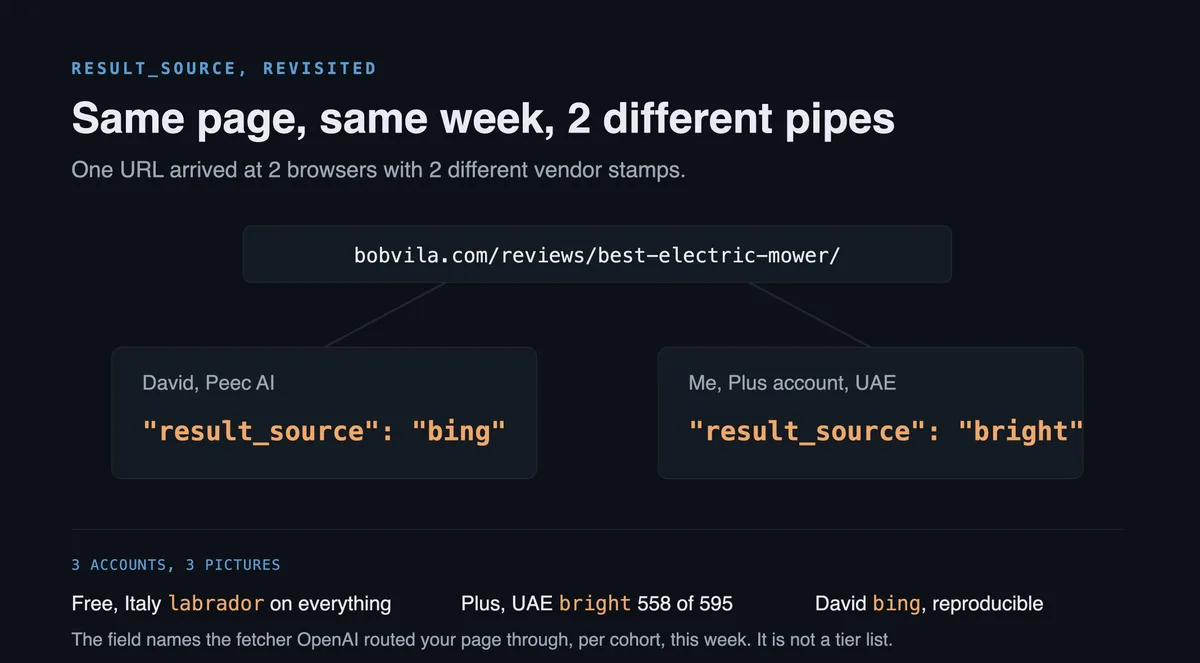
David Konitzny, a GEO researcher at Peec AI, noticed the value first and reproduced it across several prompts. Suganthan Mohanadasan, whose earlier capture the first article retells, then requested the same URL that appeared in Konitzny’s capture, a bobvila.com review page, and got it delivered through a different pipe: Bright Data on his account, Bing on Konitzny’s. His reading is that OpenAI is rolling out a fifth pipe cohort by cohort, enabled for some accounts and not others, which he calls “completely normal engineering.”
What the field says and what it does not
result_source labels internal routing, not attribution. A result fetched through this pipe does not mean the user sees it credited as a source in the answer. The field records which machinery delivered the page into the model’s working context, nothing more.
Nor is the arrangement a secret. OpenAI’s own documentation for ChatGPT Search says queries may be sent to third-party search providers, and its enterprise materials name Bing directly. What the traffic adds is granularity: the route now depends on the query, the mode and the account, and this supplier is one of five. Its share of the mix is something OpenAI can change without announcing it, so “ChatGPT switched to Bing” is the wrong summary.
When Google rankings and ChatGPT citations part ways
If part of the retrieval runs through a different index, a site’s presence in ChatGPT answers can diverge from its Google performance. Glenn Gabe documented one case in June: a YMYL site with over 90,000 ChatGPT citations that was nearly invisible in Google, ranking beyond page seven or eight for most queries. The same site had over 88,000 URLs indexed in Bing against over 45,000 in Google, and its Copilot citations tracked its Bing rankings. Gabe considers that site an example of scaled content abuse and expects it to be demoted, so it is evidence of the mechanism, not of a strategy to copy.
The reverse is plausible but undocumented here: a site strong in Google and thinly indexed in Bing could be losing citations to weaker competitors without noticing.
A short check in Bing Webmaster Tools
Bing has been a footnote in most Google-only routines, so a quick look is cheap. We have not run this on cyberlab.team for this article, so what follows is the minimum to verify, not a result.
- Open Bing Webmaster Tools and see whether the pages that answer commercial questions are indexed: services, pricing, product pages, cornerstone guides, not just the homepage.
- Look for crawl errors that never appeared in Google Search Console, and confirm your XML sitemap parses.
- Check IndexNow. Bing supports push indexing, and many CMS platforms have a plugin or setting for it.
- Make sure your firewall is not blocking crawlers or whole countries. Suganthan’s warning is that an aggressive WAF or geo-block can cut a site off from an entire retrieval pipe without any visible sign.
Keep prices, specs and documentation in plain server-rendered HTML, for the reasons given in the first article.
What the observation does not show
This is traffic observation, not an OpenAI announcement. The rollout is gated by account and could grow, shrink or disappear. Bing indexing is a plausible proxy for one pipe, not a rule for citations: comparing the URLs ChatGPT cites against Bing’s results may explain some that Google positions cannot, but four other pipes exist. For classic organic traffic, Google remains the main channel in most niches. For AI visibility, the inputs are plural, and one of them now has a name in the logs.
Sources
- Suganthan Mohanadasan, “ChatGPT Changed How It Picks Sources (Part 2),” 14 July 2026: suganthan.com
- David Konitzny, LinkedIn post on Bing as a result source in ChatGPT: linkedin.com
- OpenAI Help Center, “ChatGPT Search”: help.openai.com
- Glenn Gabe, “Surging in ChatGPT, Dead in Google,” 22 June 2026: gsqi.com