

On 16 September Barry Adams published International SEO for Publishers in his SEO for Google News newsletter. His conclusion is blunt: a publisher that wants readers in several countries should launch a separate country domain in each one, with a local news desk behind it, or not bother.
We think the mechanism he describes is real and the conclusion fits fewer publishers than it sounds. To check both, we read the Google documentation he links to, collected the measurements that exist on hreflang, and opened the HTML of 23 publishers that already work across borders, from The Guardian to a Ukrainian-language title published in Poland.
What Barry Adams argued, and what he left without numbers
Adams walks through four setups and rejects three. One generic domain works only for brands as strong as The Guardian. Several languages on one domain work inside one country. The same language for several countries depends on hreflang, which he calls unworkable for news. His answer is a country domain per market. The piece contains no measurements at all.
Adams writes from what he describes as dozens of international projects for publishers, and the newsletter is an opinion from experience, labeled as such. With no sample, no case with figures and no threshold that says “below this size, do something else,” every reader has to decide alone how far the advice travels.
The new part of his argument is about timing. Hreflang annotations only count when two pages point at each other. A British article goes live and Google indexes it within minutes. An American version follows later, and both pages now carry the pair of annotations, but Google’s stored copy of the British page predates them. Until that page is fetched again, the pair is invalid. Adams puts the wait at hours and adds that in news “a gap of hours is an eternity.”
What Google’s documentation says about the four URL structures
Google lists four ways to separate markets: a country domain, a subdomain, a subdirectory and a URL parameter. It rejects only the parameter. For the other three it prints advantages and drawbacks side by side and names no winner. The drawbacks it lists for a country domain are cost, infrastructure, registry rules and being locked to one country.
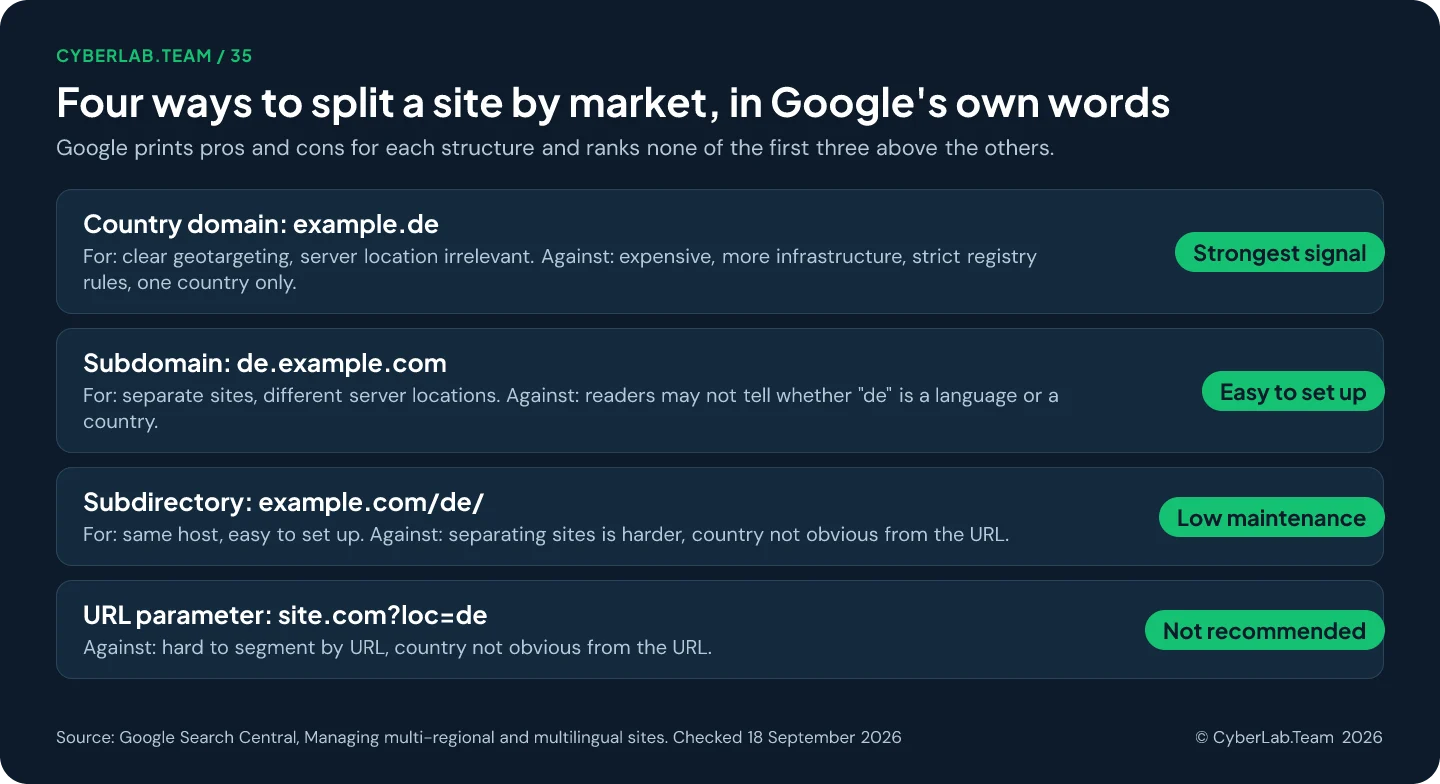
The same page, Managing multi-regional and multilingual sites, explains how Google guesses the audience of a page. A country domain comes first in the list of signals, then hreflang, then server location, then softer signs such as local addresses, currency and links from local sites. Two details matter to European publishers. Google treats .eu as a generic domain, like .com, so it carries no country signal. And Google states that it ignores the HTML lang attribute and reads the visible text instead, which agrees with what Adams says.
On one point the documentation is friendlier to hreflang than Adams is. He writes that a translated article needs no annotations because a translation is not a duplicate. Google agrees about duplicates: “Localized versions of a page are only considered duplicates if the main content of the page remains untranslated.” But the page on localized versions still says it is “usually best” to mark them up, and lists fully translated sites among the cases where it recommends doing so.
The same documentation warns against sorting readers by IP address: “Avoid automatically redirecting users from one language version of a site to a different language version of a site.” We met the practice within minutes. Requested from a Polish IP address, businessinsider.com answered with a redirect to businessinsider.com.pl, so the American edition was out of reach for us without a workaround. The same page says that most, though not all, of Google’s crawling originates in the United States and that Google does not try other locations to discover such variants.
Why hreflang loses the race in a news cycle
Hreflang counts only when both pages list each other, and Google reads that from its stored copies, which for an indexed article can be hours or days old. A version published later therefore starts with a one-sided link. For evergreen pages the delay is harmless. For a story that lives six hours, it covers the story’s whole life.
The rule is in Google’s text: “If two pages don’t both point to each other, the tags will be ignored.” The delay is on record too. On Google’s own Search Off the Record podcast in 2021, John Mueller said that “indexing takes a while to process hreflang, it has this weird delay.” The general page on asking for a recrawl speaks of “a few days to a few weeks” and says that repeating the request will not speed it up. That figure is for the web at large. Google says it fetches news sitemaps as often as the rest of the site, and busy news sites are visited far more often than that, so for a newsroom the honest range is hours, as Adams says. His own model of a fast first crawl followed by a slow second one is laid out in an earlier newsletter, and he presents it as his inference, not as something Google has confirmed.
We watched the publisher’s half of this happen. Euronews runs language editions on subdomains and links translations of an article with hreflang. A story it published at 17:57 Central European time on 18 September listed two languages, English and Portuguese, when we fetched it 65 minutes later. Four minutes after that, Italian had joined the list, and French followed half an hour later. Of eleven Euronews stories from the same day, the one-hour-old story linked two editions, six of the ten older ones linked twelve or thirteen, and the remaining four linked between one and eight, since not every story is translated everywhere. For the widely translated stories, whatever Google stored in the first minutes was an incomplete set. We did not observe Google’s index, only the pages, so this shows the cause Adams describes and not its effect on rankings.
One sentence in the documentation softens the problem. Google says a site may leave some languages off some pages and it “will still process the ones that point to each other.” So a late translation leaves the existing pairs intact and joins them once Google has fetched both sides again.
Outside news, the mechanism fails for duller reasons. Ahrefs checked 374,756 domains that use hreflang in 2023 and found at least one problem on 67% of them, with reciprocal links missing on 15.3%. A separate 2023 study of 18,786 sites, published by Search Engine Land, found conflicting annotations on 31.02%. Meanwhile the Web Almanac reports hreflang on roughly 20% of pages in 2025, about twice the share of the year before. Mueller called it in 2018 “one of the most complex aspects of SEO (if not the most complex one),” and in 2024 Gary Illyes of Google agreed in public that it is “annoying” and said he was open to something better. No replacement has been announced.
What 23 publishers do in their own HTML
Most of them do without hreflang. On 18 September we fetched the front pages of 23 publishers that serve more than one country or language and one current article from 19 of them. Eight front pages carried hreflang. Four articles linked to a version in another language. No publisher linked two versions of one article written in the same language.
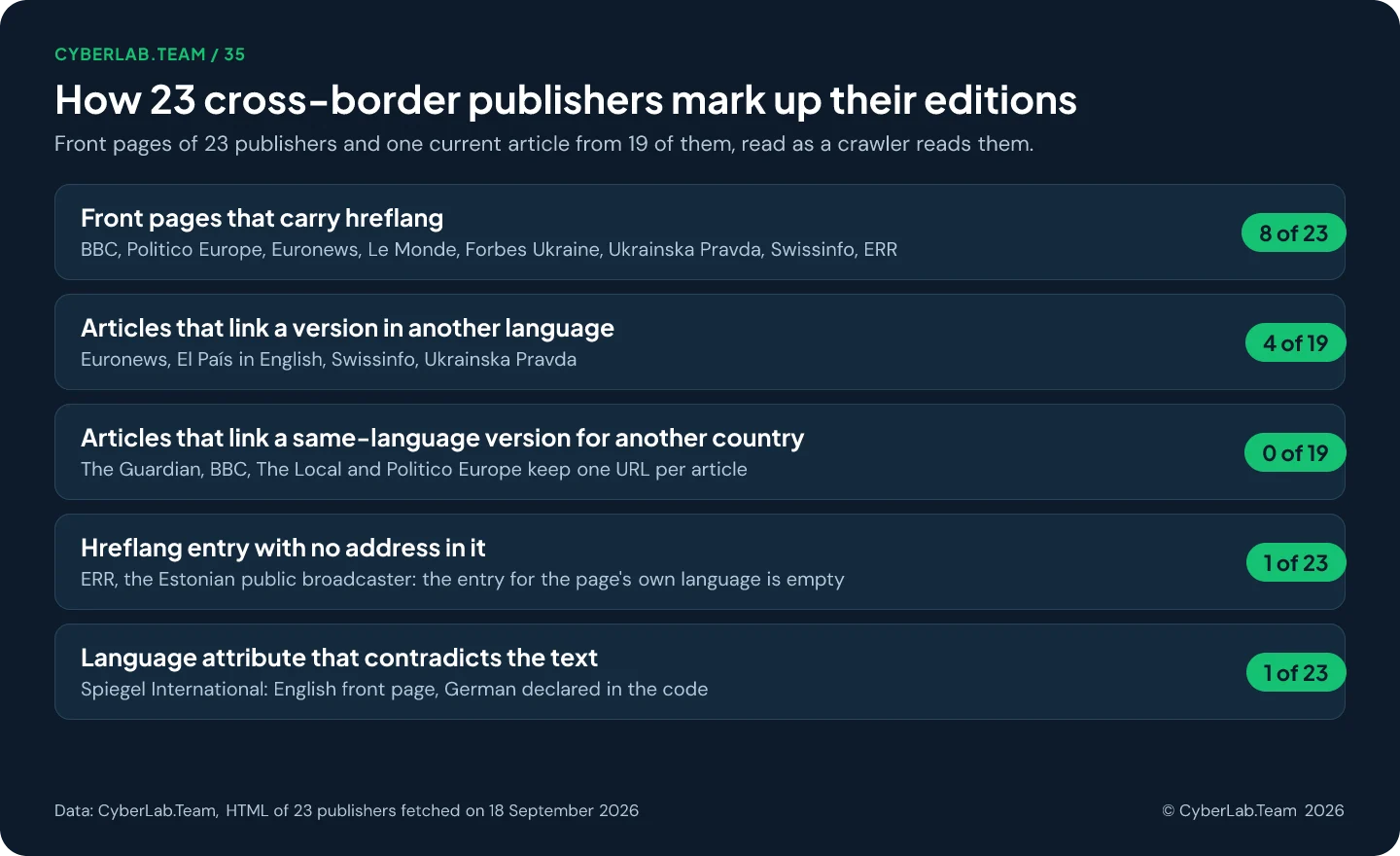
The same-language group is the one Adams writes about, and it behaves as he says. The Guardian runs separate front pages by region. The two we fetched, international and Europe, carry no hreflang, and neither does the article we opened or the news sitemap, which listed more than 500 articles. BBC links bbc.com and bbc.co.uk to each other on the front page and not on the article we opened. The Local publishes in English for foreigners living in Europe and gives each country its own domain. Its main site links to nine of them, from thelocal.at to thelocal.se, and the German and French front pages we fetched carry no hreflang. Politico Europe annotates its articles, but only with a link to themselves.
The publishers that do link articles all translate them. Euronews, El País in English, Swissinfo and Ukrainska Pravda connect each story to its counterpart in another language. Ukrainska Pravda keeps Ukrainian, Russian and English under one domain and one article number, and every version we opened listed all three in both directions. Deutsche Welle takes the opposite route. Its English front page links to 30 language sections on one .com domain, and neither its pages nor its English news sitemap carry hreflang.
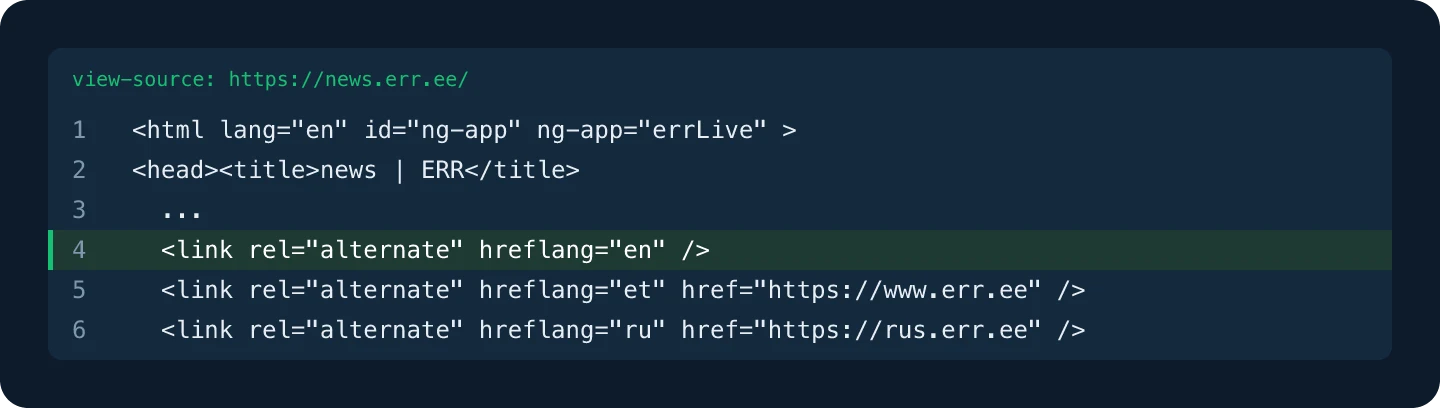
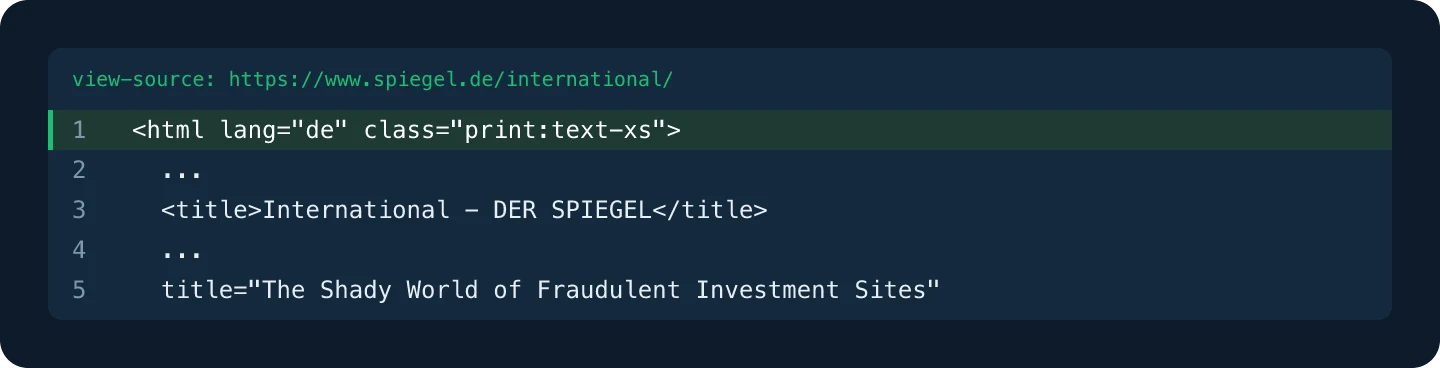
We also found the kind of fault the large studies count. The Estonian public broadcaster ERR links its Estonian, Russian and English sites with hreflang, but the entry for the page’s own language has no address in it, so no version lists itself as Google requires. The front page of Spiegel International is in English and declares German in its lang attribute. Google ignores that attribute, as quoted above. Browsers, screen readers and other search engines do not. Le Monde in English declares one URL for readers in the US, the UK, Canada and everywhere else, which is harmless and adds nothing to a plain English label.
Where the country domain advice stops working
A country domain is the strongest location signal Google names, and it starts from nothing. It has no links, no history and no brand searches, and those are what a newcomer competes on. Practitioners who merged country domains into one site have reported large gains. None of those cases is a newsroom, which is the fair limit of the counterargument.
Aleyda Solís put the trade in one sentence in 2015: country domains are the ideal option, but “a brand-new domain with no link profile may require much more effort to grow in popularity.” Eli Schwartz described in 2017 how Google ranked a .com above the same company’s country domain in its own country. John Mueller’s reply at the time was that this “can happen when we fold the versions together (usually if it’s the same content).” Same-language country sites with near-identical articles are exactly that case.
Two documented mergers went the other way from Adams’s advice. Bartosz Góralewicz moved a coupon site’s 23 country domains onto one domain in 2016 and reported an average rise of 841% in a visibility index, with Russia falling by 16%. Eoghan Henn reported 90% more organic traffic in five months for a telephony company after a similar move. Both authors ran the projects they describe, neither client publishes news, and Henn himself warns that merged sites share their problems as well as their strengths. The BBC, a newsroom by any definition, has spent years moving its international audience onto bbc.com and gave efficiency as the reason.
On reader trust there is one survey with a method behind it. ICANN and Nielsen asked 5,452 people in 24 countries in 2016 and found that 95% considered country domains trustworthy “in regions where they are commonly used.” It is ten years old and measures trust, not clicks. While collecting sources we met several sharper claims, such as a 47% higher click rate for local domains and a Eurostat survey showing 72% preference. We could trace none of them to a page, and they are not in this article.
Who a European publisher’s second audience is
In Europe the second audience is often not abroad at all. It lives in the publisher’s own country and reads another language, or it left the country and still reads the language of home. Eurostat counts 18 million EU residents born in another member state and 4.43 million people from Ukraine under temporary protection, 953,060 of them in Poland.
Those figures come from Eurostat’s population statistics for 1 January 2025 and its monthly release on temporary protection for 31 July 2026. Germany hosts 1,290,225 of the people who fled Ukraine, Poland is second, and Eurostat notes that Poland’s regular population statistics leave them out. For a publisher that is a readership the size of a large city, inside one country, in a language the national press does not print.
Language habits point the same way. The European Commission’s survey of internet users found that nine in ten always chose their own language when a site offered it, and 44% felt they missed information because a site did not. That survey is from 2011, with 13,752 interviews, and nobody has repeated it. The newer Europeans and their Languages study, run in 2023 with 26,523 respondents, shows the other half: among people who speak a second language, 44% regularly use it online, nine points more than in 2012. Readers cross language borders more easily than they did, and still prefer not to.
The domain itself is the cheap part. CENTR, the association of European registries, puts the typical price of a European country domain at around 10 euros. What differs is who may hold one. Poland’s .pl and Estonia’s .ee are open to foreign registrants. France’s .fr, Italy’s .it and .eu require a holder in the EU or the wider European Economic Area, and the French and Italian registries also admit Switzerland. Germany’s .de is open, but a holder outside Germany can be asked to name a representative there for legal papers. A second-level .ua name is granted only to the owner of a matching trademark valid in Ukraine. Google’s phrase for this is “strict ccTLD requirements (sometimes).”
The payoff side has moved too. The Digital News Report 2026 cites Chartbeat data for more than 2,500 news sites: Google’s organic search traffic to them fell by a third worldwide between November 2024 and November 2025. Google still holds 89.69% of search in Europe, so search remains the channel to get right. But a second newsroom financed on the expectation of growing search traffic is a harder case to make in 2026 than it was five years ago.
A service site is not a newsroom
The hours that sink a news story do not matter to a page that earns its traffic over months. Most multilingual sites are of that kind: shops, agencies, software companies, and the evergreen sections of publishers themselves. For them a subdirectory per language with hreflang remains a sound setup, and the delay Adams describes costs nothing worth measuring.
Our own site is built that way: English at the root, Ukrainian, Russian and Polish in subdirectories, every page annotated. Preparing this article we checked it as we checked everyone else and found our own fault. The pages declare plain language codes, en, uk, ru and pl. The XML sitemap, generated by a different tool, declares en-US, uk-UA, ru-RU and pl-PL for the same URLs. One of those tells Google that our Russian pages are meant for readers in Russia, where we have no clients, when the people who read them live in the EU and Ukraine. Google’s documentation says the three annotation methods are equivalent and that running several at once brings no benefit and is harder to manage. Update after publication: fixed. The sitemap now declares the same plain codes as the pages, and our build fails if the two ever disagree again.
What a small or regional publisher can do instead
The right structure depends on where the second audience lives. If it lives in the same country, one domain with clean language sections is enough. If one language crosses borders, keep one URL per story. A publisher entering a new country on a small budget can begin in a subdirectory and decide in advance when a country domain becomes worth its cost.
The first case is the one Adams clears himself, and it describes much of Europe’s migrant and minority press. Nasz Wybir publishes in Ukrainian for Ukrainians in Poland on a .pl domain, so the country signal and the audience agree and only the language differs. A title like that has no use for a second domain. It needs each language in its own section with its own URLs, a separate publication in Publisher Center for each language, because Google’s technical guidelines ask for exactly that, and the correct <news:language> value in each news sitemap. Articles that mix two languages on one page are excluded from Google News by the same guidelines.
The second case, one language in several countries, is where the temptation to clone articles is strongest and the evidence against it is clearest. Every same-language publisher we measured keeps a single URL per article and varies only the front page, and Google’s canonicalization guide names US and UK copies of one text as its example of duplicates. If a partner site abroad republishes your stories, Google’s advice for news is not a canonical link but a noindex tag on the partner’s copy, either for Google News alone or for Search as well.
The third case is the expensive one. A subdirectory inherits the links and reputation of the main domain from the first day, which is what a new country domain lacks. Its weakness, in Google’s words, is that “separation of sites” is harder, and a reader cannot tell a country from a folder name. We would treat it as a trial period with written exit conditions: a reporter based in the country, links earned from local sites, and readers searching for the title by name. When those exist, the country domain has something to stand on.
Whatever the structure, a few habits cost nothing. Use one hreflang method and generate it from the same data that creates the translations, so that a version is listed only once it exists and both sides change in the same deployment. When the second market matters for a story, publish the two versions together so the first crawl sees the complete pair. Keep visible links between language versions, since Google recommends them and readers who land on the wrong one need a way out. Do not redirect by IP address. This week, fetch your own front page and one fresh article and read the annotations as a crawler would, because both faults we found on other sites, and the one on ours, were visible in the raw HTML within a minute. After that, watch whether Google replaces hreflang at all: its own engineers have said they would like to, and have shown nothing yet.
What we did not measure
Our count covers one day, one IP address in Poland, the HTML of front pages and a single article per site, plus two news sitemaps. Annotations kept only in other sitemaps are invisible to it. We did not see Google’s index, rankings or traffic for any publisher, so nothing here proves how much the timing gap costs.
Four sites refused our request and are left out, and the 23 publishers are a hand-picked list of cross-border titles, not a sample of the industry. The Euronews observation is eleven articles on one afternoon. The studies we cite on hreflang errors cover websites in general, and none of them separates news publishers. The consolidation cases come from the consultants who ran them. Adams’s own account of Google’s two-speed crawling is, as he says himself, a model inferred from practice.
Within those limits, three things hold. The timing problem is real and specific to news, and the publishers we measured avoid it by not cloning articles. A country domain is the strongest signal and the most expensive start. For most publishers below national scale there is a cheaper setup that fits, and which one depends on where their second audience lives.
Sources
- Barry Adams, International SEO for Publishers, SEO for Google News, 16 September 2026
- Barry Adams, Why Articles Should Be Optimised Before Publishing, 4 October 2023
- Google Search Central, Managing multi-regional and multilingual sites
- Google Search Central, Tell Google about localized versions of your page
- Google Search Central, How Google crawls locale-adaptive pages
- Google Search Central, Ask Google to recrawl your URLs
- Google, Optimize your crawl budget
- Google Search Central, News sitemaps
- Google Search Central, What is canonicalization
- Google Search Central, How to specify a canonical
- Google Search Central, Fix canonicalization issues, syndicated content
- Publisher Center Help, Avoid article duplication in Google News
- Publisher Center Help, overview and News content across Google
- Publisher Center Help, Technical guidelines
- Search Console Help, The International Targeting report is deprecated
- Google, Search Off the Record, How serving works, hreflang, and more, 2021, John Mueller and Gary Illyes
- Search Engine Roundtable, John Mueller on hreflang as the most complex aspect of SEO, 19 February 2018
- Search Engine Roundtable, Gary Illyes open to alternatives to hreflang, 3 May 2024
- Search Engine Roundtable, John Mueller: hreflang does not guarantee indexing, 13 May 2025
- Ahrefs, Patrick Stox, study of 374,756 domains using hreflang, 2023
- Search Engine Land, Dan Taylor, study of 18,786 sites with hreflang, 4 April 2023
- Semrush, the most common hreflang mistakes, 20,000 sites, 2017
- HTTP Archive, Web Almanac 2025, SEO chapter and the 2024 edition
- Aleyda Solís, 5 questions to select the right structure for your international websites, Search Engine Land, 2015
- Eli Schwartz, subdomain, subdirectory or ccTLD, Search Engine Journal, 2017, with John Mueller’s reply
- Bartosz Góralewicz, one global domain vs. multiple TLDs, case study, Ryte Magazine, 2016
- Eoghan Henn, ccTLD vs. gTLD, case study, searchVIU, 2018
- OnlineDomain, the BBC’s own explanation of the move from bbc.co.uk to bbc.com, 2019
- ICANN and Nielsen, Global Consumer Survey, 5,452 respondents in 24 countries, 2016
- Reuters Institute, Digital News Report 2026, executive summary and the Poland chapter
- European Commission, Flash Eurobarometer 313, User language preferences online, 2011
- European Commission, Special Eurobarometer 540, Europeans and their Languages, 2024
- Eurostat, EU population diversity by citizenship and country of birth
- Eurostat, Temporary protection for persons fleeing Ukraine, monthly statistics
- Centre for Media Pluralism and Media Freedom, Uncovering news deserts in Europe, 2024
- CENTR, Global TLD Report, edition 1/2025
- Registry rules: AFNIC for .fr, Registro.it for .it, DENIC for .de, NASK for .pl, Estonian Internet Foundation for .ee, Hostmaster for .ua, EURid for .eu
- StatCounter, search engine market share, Europe, August 2026
- Our own measurement: HTML of 23 publishers and the Euronews hreflang log, fetched on 18 September 2026