

On October 1, 2026 Google changed the document I would hand to anyone who asks how Google thinks about content quality: Creating helpful, reliable, people-first content. The guide gained a section that defines “main content”, four qualities that search quality raters are trained to judge it by, and a paragraph that calls fake author profiles deception.
Marie Haynes was the first to write it up the next day, with a handy comparison table. We compared the new page with archived copies line by line and traced each new sentence back to the rater guidelines it came from. This article covers what Google added, what it did not say, and what a small business site should check.
What did Google change on October 1?
Google made four additions to the guide and left the rest untouched. A sentence ties page quality to the rater guidelines, a new section defines main content and lists four qualities raters assess, and the “Who” section now warns against invented author profiles. Google’s documentation changelog does not list this edit.
The previous version, last updated on December 10, 2025, was still online in the Wayback Machine copy taken at 15:48 UTC on October 1. The current page carries the date October 1, 2026. When we compared the two texts, nothing else had moved. The additions are:
- A sentence at the end of the E-E-A-T section saying the Search Quality Evaluator Guidelines treat the quality of the main content as “one of the most critical factors for assessing page quality”.
- A new “Main content” section with a definition and five kinds of main content.
- Four attributes raters are “trained to evaluate”: effort, originality, talent or skill, and accuracy.
- A paragraph against deceptive authorship.
On the same day Google also updated a sister page, Using generative AI content. That one did make the documentation changelog, with the note that it now carries “information from the Search Quality Raters guidelines” and the reason “to get our documentation in sync with our presentations we use at our developer events”. As of the evening of October 2, the helpful content page has no changelog entry of its own. Coverage outside Marie Haynes’s post was thin on day one: Search Engine Roundtable wrote about the main content section and Search Engine Journal about the fake author paragraph.
What counts as main content now
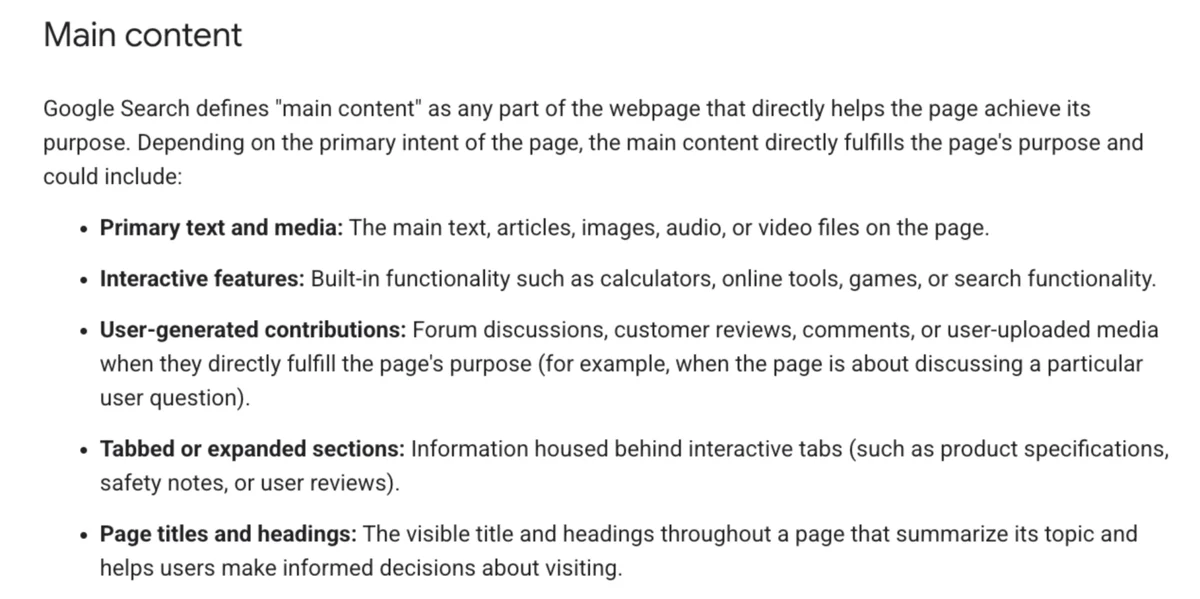
Main content is whatever on the page directly does the job the page exists for. Google’s list is broader than the article text: it takes in tools, user reviews and comments when they serve the purpose, information sitting in tabs, and the visible title and headings. Menus, footers and ads are not on the list.
Google’s definition: main content is “any part of the webpage that directly helps the page achieve its purpose”. Depending on the page, it could include:
- primary text and media: the text, images, audio and video;
- interactive features: calculators, online tools, games, search;
- user-generated contributions: forum discussions, customer reviews, comments and uploaded media, “when they directly fulfill the page’s purpose”;
- tabbed or expanded sections: product specifications, safety notes or reviews behind tabs;
- page titles and headings: the visible title and headings “that summarize its topic and helps users make informed decisions about visiting”.
Two items on that list get little attention in the early coverage. Titles and headings now count as main content, which fits Google’s title link documentation: Google builds the title shown in results from the title element, the main visual title and heading elements. And reviews or comments count only when they serve the page’s purpose. On a page about a user’s question, the discussion is the content. Under a service description, a comment thread is something else. Where comments are part of the page, Google’s own advice still applies: mark their links with rel="ugc" and moderate them, because comment spam on your page is your problem.

The four qualities raters are trained to look for
The new section names four attributes of main content: effort, originality, talent or skill, and accuracy. Each comes with a short explanation and an example. Google presents them as what raters assess. That makes them the yardstick of its quality evaluations, and the guide does not claim any of them is a ranking switch.

Effort is “the extent to which human work went into creating the content or the systems powering it”. Original analysis, a poem translated by hand or a custom interactive map are Google’s examples of high effort. Pages generated from feeds, or large amounts of text produced with generative AI “without manual oversight or curation”, are its examples of little to no effort. The last sentence of the paragraph is the one I would print for any content team that works from other people’s material: “Attribution or giving credit to other sources doesn’t replace the need for original effort.” Linking to the article you retold does not turn the retelling into effort.
Originality means information or perspectives “that aren’t already available on other websites”.
Talent or skill covers the ability needed to give visitors a satisfying experience: clear writing, well-produced video, page tools that work. Google adds that not every topic needs special expertise. Someone describing a new way to clear snow from a driveway does not need credentials.
Accuracy applies to informational pages. For topics that can significantly affect people’s lives or well-being, which Google calls YMYL, content “must be highly accurate and consistent with established expert consensus”.
Fake authors are now named in the guide
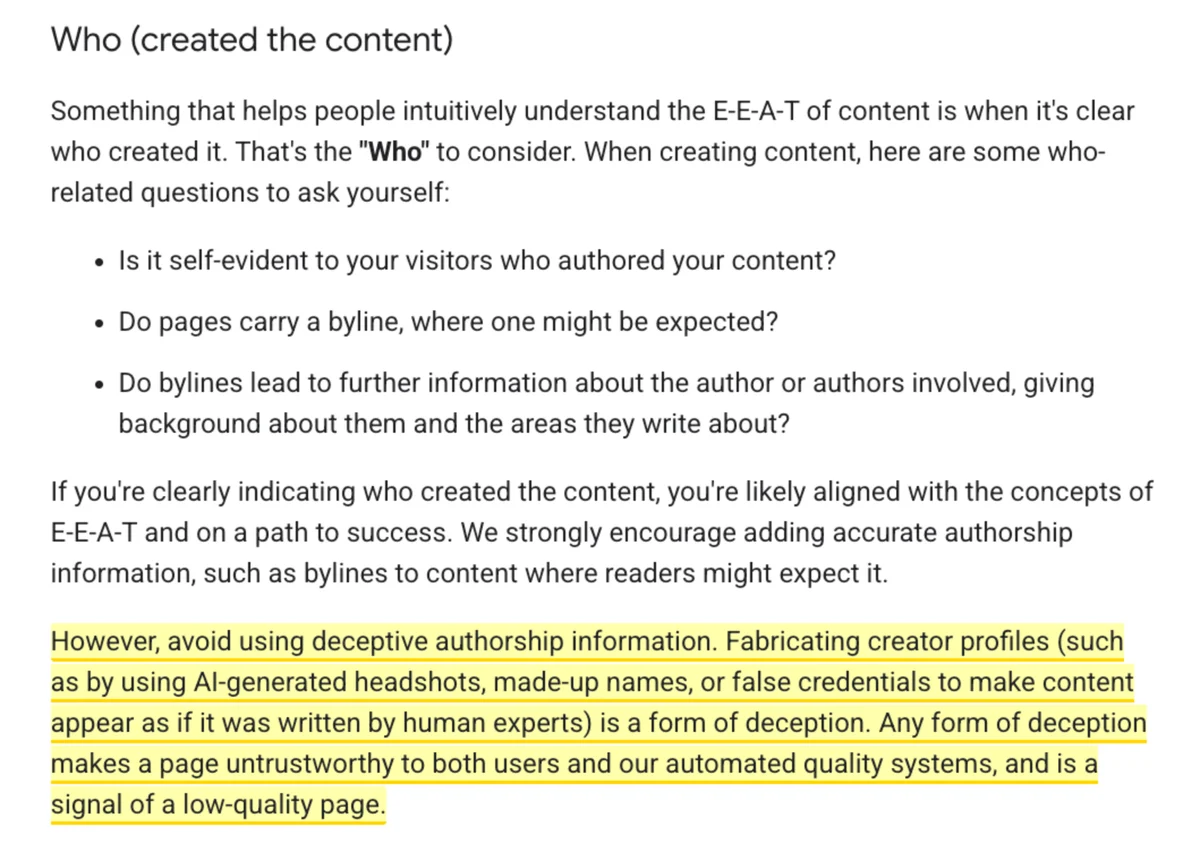
The “Who created the content” part of the guide already asked for bylines where readers expect them. It now adds that inventing creator profiles, with AI-generated headshots, made-up names or false credentials, is deception, and that deception makes a page untrustworthy to users and to Google’s “automated quality systems”.
The full new paragraph sits right after Google’s long-standing advice to add “accurate authorship information, such as bylines”:
Publishers have been caught doing exactly this. In November 2023 Futurism reported that Sports Illustrated had published product reviews under authors who did not appear to exist, one of them with a profile photo that was on sale on a site selling AI-generated headshots. The publisher said the content came from a contractor and denied it was written by AI. The fake identities themselves were not in dispute. Earlier that year CNET acknowledged corrections to short stories made with an AI tool, after Futurism found errors behind a “CNET Money Staff” byline, and moved the disclosure where readers could see it.

Google’s spam policies do not list fake author profiles as a separate violation, and Google does not say how its systems would detect one, as Search Engine Journal noted. Bylines were never a ranking lever either. In January 2024 Google’s Search Liaison wrote that “just adding a byline doesn’t give a ranking boost”, and John Mueller said in 2021 that the author is not a direct ranking factor. So the new text works in one direction only: a real author earns no points, while an invented one is called a signal of a low-quality page. Author markup does not help an invented author. Google’s Article structured data guide recommends author.name and author.url so that Google can identify a person, which only works if the person exists.
Where the new text comes from
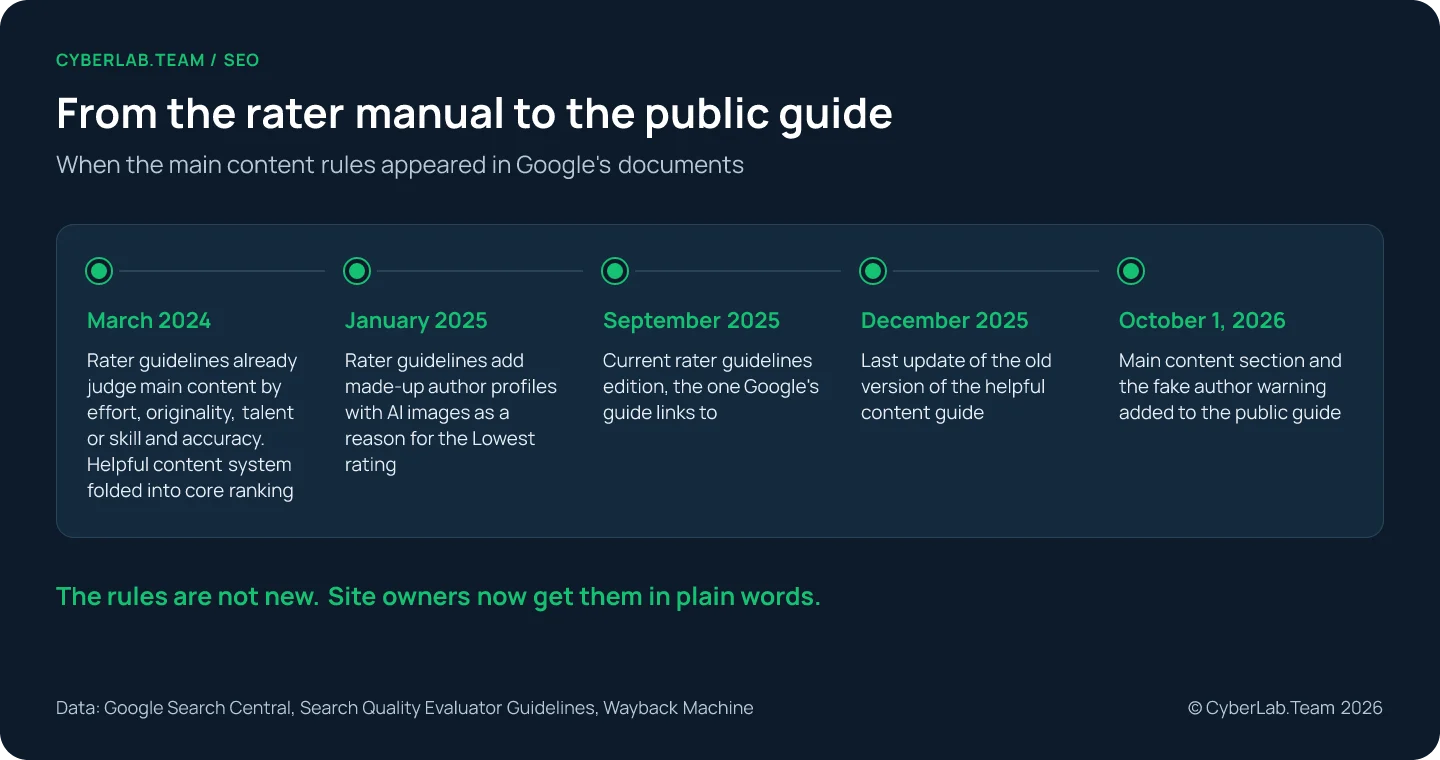
Almost every new sentence already existed in the rater guidelines, the manual Google’s search quality raters work from. The main content definition, the four attributes and the rule on fake author profiles were all there. The October update copied them into the public guide for site owners, in plainer words and with a few new examples.

We compared the new section with the guidelines edition dated September 11, 2025, the one the guide links to:
- The definition is section 2.4.1 almost word for word: “Main Content is any part of the page that directly helps the page achieve its purpose.” The same section says tab content “may be considered part of the MC” and that the MC “also includes the title at the top of the page”.
- Effort, originality, talent or skill and accuracy are section 3.2, where the quality of main content “can be determined by the amount of effort, originality, and talent or skill”. That paragraph was already in the March 2024 edition.
- The attribution sentence moved from section 4.6.6, where pages built from copied content “should be rated Lowest, even if the page assigns credit for the content to another source”.
- Fake profiles are section 4.5.3: “AI generated content with made up “author” profiles (AI generated images or deceptive creator descriptions)“. That bullet first appears in the January 2025 edition. The March 2024 edition does not have it.
Some lines are new to the public guide. The snow driveway example and the interactive game map are not in the rater guidelines, “headings” was added next to “title”, and the phrase “automated quality systems” has no rater guideline source. The guide is also firmer on YMYL: raters are asked to “consider the extent” of accuracy, while site owners are told content “must be highly accurate”.
Does this change rankings?
The edit itself does not change rankings. Google says rater scores do not move individual pages, and a documentation edit is not an algorithm update. Rater scores do help train and test some of Google’s ranking models, which is why the yardstick matters. Marie Haynes expects a core update soon; that is her forecast, not a Google announcement.
Google’s wording on raters has not changed in years. The guide itself says “Rater data is not used directly in our ranking algorithms” and compares ratings to feedback cards in a restaurant. Its page on search testing says the ratings “do not directly impact ranking” but help benchmark quality. Google’s 2023 overview of the rater guidelines goes a step further: ratings “are used to improve our systems by giving them positive and negative examples of search results”.
The court record fills in part of the gap. In the US antitrust case, Judge Mehta’s remedies opinion of September 2, 2025 describes RankEmbed and RankEmbedBERT as ranking models that rely on search logs “plus scores generated by human raters”. So rater judgments do reach machine-learned ranking, as training data for some models. What the opinion does not say is which rater criteria those scores capture. Marie Haynes writes that Google “uses these guidelines to train machine learning models”; the narrower version is supported by the record, the step from there to “the four attributes are what the models learn” is inference.
Her other point is about timing. Google announced its new frontier model Gemini 4 Argon on September 30, 2026, and she suspects that a jump in model capability will improve ranking systems and bring a significant core update. The announcement says nothing about Search, so I read this as a reasonable guess from an experienced observer. One more piece of context: the separate helpful content system no longer exists. Google folded it into core ranking in March 2024, saying there is “no longer one signal or system” for helpfulness.
Where we read the update differently from Marie Haynes
Marie Haynes’s table is a useful quick summary, and her advice is sound. In three places, though, it credits this page with more than the page says, so we separate her advice from Google’s text.
- On hallucinations, her table says the accuracy attribute “specifically cautions against unreviewed AI hallucinations”. The helpful content page does not mention hallucinations. That wording is on the sister page updated the same day, Using generative AI content, which now says generative AI output “may contain inaccuracies (also known as hallucinations)” and that it is “critical to manually factcheck and review all AI-generated content”. The review requirement also covers title elements, meta descriptions, structured data and image alt text.
- On tabs, her table says Google “clarified that tabs and accordions are acceptable for layout cleanliness as long as content is accessible”. The new section only lists tabbed sections as a kind of main content. Google’s acceptance of tabs lives elsewhere: the spam policies say accordion and tabbed content “don’t violate our policies”, and the mobile-first indexing guide says Google “won’t load content that requires user interactions”. An experiment by Merj found the same: text present in the HTML behind a tab was indexed, text fetched only after a click was not.
- Her “Skill & Experience” row merges two ideas. Google’s attribute is “talent or skill”, and its example says that expertise is not always required. YMYL appears under accuracy.
She also leaves out the attribution sentence under effort and the titles and headings item, which for many small sites are the two most practical lines in the update.
What this means for a small business site
For a small business the update mostly confirms what a good service page already does. The main content of a service page is the description of the service, the prices or how they are set, the process, the answers to common questions, the reviews when the page is about reviews, and the form. Everything around it is supporting material.
A few patterns we see on small business and agency sites now sit squarely in the text Google published:
- Invented team members. “Our specialist Anna” with a stock or AI-generated photo is exactly the “made-up names” case. A real person, even without a photo, is better than a pleasant invention.
- Rewritten articles with a source link. The attribution sentence is aimed at them. If a blog post retells someone else’s article, the link does not make it original.
- AI-written text published without a review. Google has said since 2023 that it judges quality however content is produced, and its sister page now asks for a manual fact check, and the same check applies to titles, descriptions and alt text written by AI. At scale, the spam policies already call generating “many pages without adding value for users” scaled content abuse.
- Fake or unchecked reviews. If customer reviews are part of a page’s main content, they need to be real. In the EU this is already law for businesses selling to consumers: the Unfair Commercial Practices Directive bans claiming reviews come from real customers without reasonable checks, and bans posting or commissioning fake ones.
There is one more EU point for sites that publish AI-assisted articles. Article 50(4) of the AI Act, which applies from August 2, 2026, requires disclosure when AI-generated text is published to inform the public on matters of public interest, unless a human has reviewed it and a person holds editorial responsibility. The Digital Omnibus on AI adopted in July 2026 did not change that paragraph. The Commission’s guidelines on Article 50, which are not binding, say fact checking is the minimum for that review and that whoever holds editorial responsibility should be easy to find. Whether a given marketing blog post counts as “public interest” is not settled, and this is not legal advice. Still, Google’s guide and the EU text now point the same way: a real, named person who checked the facts. Our own editorial policy is built on that.
What to check now, this week, and later
Start with the pages that bring leads, not the whole site. Check that the main answer is visible near the top, that titles and headings describe the page truthfully, that every author is a real person, and that AI-assisted text was fact checked. Then give it weeks before reading the results.

Today, open your three most important pages and ask of each: what is this page for, and does the first screen deliver it? If the price, the answer or the tool sits below an introduction nobody asked for, move it up.
This week:
- Go through the authors on your site. Remove or replace any profile that is not a real person, and correct any credential that is not true.
- Read the title and H1 of each key page as a stranger would. Do they summarize the page, or only repeat a keyword?
- Check that content in tabs and accordions is in the page HTML on load rather than fetched after a click: open the page source and search for a sentence from inside a tab.
- List the AI-assisted texts, including titles, meta descriptions and alt text, and check them against their sources.
After that, watch and wait. A documentation change is not a ranking update, and Google’s core updates guide says it “could take several months” for its systems to confirm that a site as a whole is producing helpful content. Compare the same pages in the Search Console Performance report over comparable date ranges. If a core update arrives, Google recommends waiting at least a full week after it completes before analyzing the results.
If you would rather have someone go through your pages with you, that is what our SEO site audit covers.
Sources
Google, primary:
- Google Search Central, “Creating helpful, reliable, people-first content”, last updated October 1, 2026: developers.google.com; previous version (last updated December 10, 2025) in the Wayback Machine, October 1, 2026, 15:48 UTC: web.archive.org
- Google Search Central, “Using generative AI content”, last updated October 1, 2026: developers.google.com
- Google Search Central, “Latest documentation updates”, entry of October 1, 2026: developers.google.com
- Google, Search Quality Evaluator Guidelines, edition of September 11, 2025, sections 2.4.1, 3.2, 4.5.3, 4.6.5, 4.6.6: static.googleusercontent.com; editions of March 5, 2024 and January 23, 2025 in the Wayback Machine: March 2024, January 2025
- Google, “Search Quality Rater Guidelines: An Overview”, November 2023: services.google.com
- Google, “Search Engine Testing & Evaluation” (How Search works): google.com
- Google Search Central Blog, Elizabeth Tucker, “Our latest update to the quality rater guidelines: E-A-T gets an extra E for Experience”, December 15, 2022: developers.google.com
- Google Search Central Blog, “What web creators should know about our March 2024 core update and new spam policies”, March 5, 2024: developers.google.com
- Google, Elizabeth Tucker, “Google Search: New updates to address spam and low-quality results”, March 5, 2024: blog.google
- Google Search Central, “A guide to Google Search ranking systems”: developers.google.com
- Google Search Central Blog, Danny Sullivan and Chris Nelson, “Google Search’s guidance about AI-generated content”, February 8, 2023: developers.google.com
- Google Search Central, “Spam policies for Google web search”, last updated August 28, 2026: developers.google.com
- Google Search Central, “Article structured data”: developers.google.com
- Google Search Central, “Influencing your title links in search results”: developers.google.com
- Google Search Central, “Mobile site and mobile-first indexing best practices”: developers.google.com
- Google Search Central, “Qualify your outbound links to Google”: developers.google.com and “Prevent user-generated spam on your site and platform”: support.google.com
- Google Search Central, “Google Search’s core updates” and “Debugging drops in Google Search traffic”: core updates, traffic drops
- Search Console Help, “Performance report (Search results)”: support.google.com
- Google, “Introducing Gemini 4 Argon”, September 30, 2026: blog.google
- Google Search Liaison on X, January 8, 2024: x.com
Court and EU texts:
- United States v. Google LLC, No. 20-cv-3010 (D.D.C.), Memorandum Opinion on remedies, September 2, 2025 (Document 1436): courtlistener.com; Memorandum Opinion on liability, August 5, 2024 (Document 1033): courtlistener.com
- Regulation (EU) 2024/1689 (AI Act), Articles 50 and 113: publications.europa.eu
- Regulation (EU) 2026/1744 (Digital Omnibus on AI): publications.europa.eu
- European Commission, guidelines on the transparency obligations of Article 50 of the AI Act, July 20, 2026: digital-strategy.ec.europa.eu
- Directive (EU) 2019/2161 amending the Unfair Commercial Practices Directive, Annex I points 23b and 23c: publications.europa.eu
Practitioners and reporting:
- Marie Haynes, “Google changed their helpful content guidelines to emphasize good ‘Main Content’”, October 2, 2026: mariehaynes.com
- Barry Schwartz, “Google Helpful Content Doc With New Main Content & EOT/SA Sections”, Search Engine Roundtable, October 2, 2026: seroundtable.com, and “Google: Manually Factcheck & Review AI-Generated Content For Accuracy”, October 1, 2026: seroundtable.com
- Matt G. Southern, “Google Adds Fake Author Warning To Helpful Content Guidance”, Search Engine Journal, October 2, 2026: searchenginejournal.com
- Barry Schwartz, reports on the rater guidelines editions of January 23, 2025 and September 11, 2025, Search Engine Roundtable: January 2025, September 2025
- Barry Schwartz, “Google Says Author Not A Direct Ranking Factor”, Search Engine Roundtable, October 22, 2021: seroundtable.com
- Maggie Harrison Dupré, “Sports Illustrated Published Articles by Fake, AI-Generated Writers”, Futurism, November 27, 2023: futurism.com
- Connie Guglielmo, “CNET Is Testing an AI Engine. Here’s What We’ve Learned, Mistakes and All”, CNET, January 25, 2023: cnet.com; Jon Christian, “CNET’s Article-Writing AI Is Already Publishing Very Dumb Errors”, Futurism, January 17, 2023: futurism.com
- Ryan Siddle, “12 Experiments for Tabbed Content SEO”, Merj, July 12, 2021: merj.com