


A good reply to a Google review answers the review that was written, in the voice of the business, and adds nothing the customer did not already make public. The thirty examples below cover ten kinds of business, three reviews each: a positive one, a negative one and a disputed one, where the facts are unclear or the reviewer may never have been a customer.
Most collections of reply templates sort replies by star rating and then swap the business name. That works for a coffee shop and fails for a dental practice, where thanking a reviewer for “choosing us for your implant” confirms that the person was a patient and what was treated. So the examples here change with the trade: what a reply in that trade can say, what it must leave out and who should approve it.
This article is about the wording. How to set up access, ask for reviews and run replies as a routine is in our guide to running Google reviews. What to do with a review you believe breaks Google’s rules is in What a business can do about an unwanted Google review.
The rules every example follows
Google’s own advice for replies is short: be polite, keep it brief, skip the sales pitch, do not paste the same thank you under every review, and never share the reviewer’s private information. Every example below follows those rules, and each one was written to be adapted, since a reply copied word for word under twenty reviews stops reading like a reply.
The reply tips on Google’s review help page add a few specifics. Replies should be conversational rather than promotional, so a reply is not the place to offer a deal. For a complicated problem, Google suggests asking the reviewer to get in touch privately. For a negative review, it suggests admitting a mistake where there was one and explaining what the business can and cannot do.
The mechanics matter for the wording too. Only a verified Business Profile can reply, Google checks each reply against its content policies before publishing it, and the reviewer gets a notification. A reply that goes live in minutes can also take longer to clear, and the reviewer may edit the review after reading what you wrote. You can edit or delete your own reply later; you cannot change the review.
Three things never appear in the examples. There is no offer of a discount, gift or refund in exchange for changing or removing a review, because Google prohibits incentives to post, change or remove reviews. There is no customer detail the review did not contain. And there is no promise about what Google will do with a review, because the business does not decide that.
How to read the examples
Each example names the situation first, then gives a reply you can adapt and a line on why it is written that way. Replace the bracketed parts with your own contact route and sign off with a real name or initials. If a detail in the example does not match what happened, change the reply rather than the facts.
A positive review here is one that praises something specific. A negative review describes a real problem the business can look into. A disputed review is the hardest kind: the reviewer may describe another business, a decision made by someone else, or a case the business is not allowed to discuss in public.
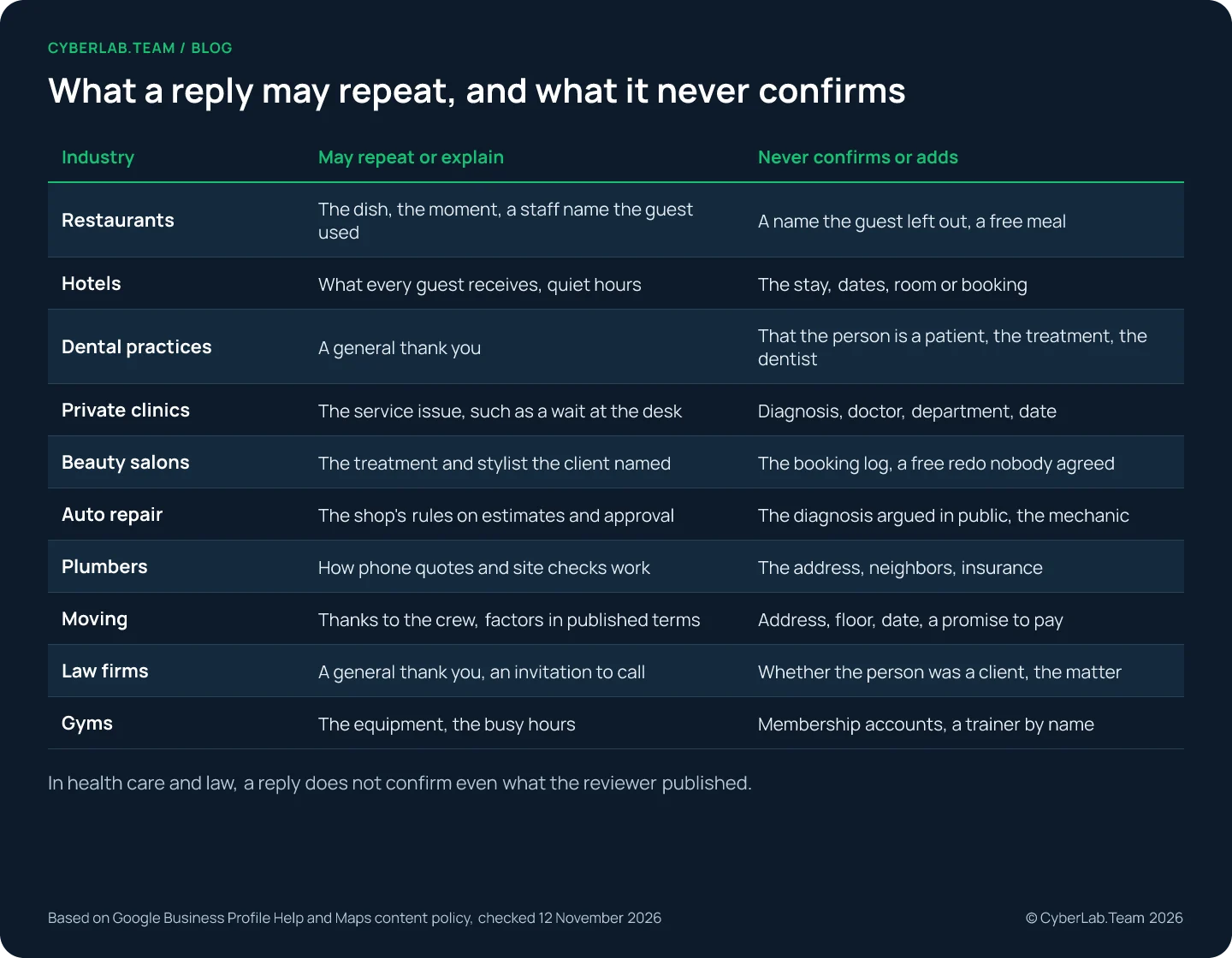
Before you send any reply, check it against what you know internally. If the review says the order was late and the records say it was not, the reply should not claim either side in public; it should give the reviewer a way to settle it. The industry pages linked in each section describe how replies work for that trade as part of monthly profile management.
Restaurants: a dish, an evening, a different venue
Restaurant reviews are about one evening, so a good reply names the dish or the moment the guest mentioned and keeps the apology short when something went wrong. Staff names appear only when the guest used them first. A review that clearly describes another venue gets a calm correction, not an accusation, and a report to Google if it breaks a rule.
More on how replies fit the rest of the profile for a kitchen: restaurants on Google Maps.
Positive review: the guest names a course and the server
The review praises the tasting menu, singles out the duck course and thanks a server called Marta.
Thank you for writing about the tasting menu, and for singling out the duck course; the kitchen will be glad to hear it. We’ll pass your thanks on to Marta too. [Name], [role]
The reply repeats only what the guest wrote. The server’s name is used because the guest used it; Google’s policy allows the names of public-facing staff, but a reply should not add a name the reviewer left out.
Negative review: a cold main course and a long wait
The guest writes that the main course arrived lukewarm after a forty-minute gap between courses.
I’m sorry your main course arrived lukewarm after such a long wait. That isn’t how a meal here should go, and I’ve shared your review with the kitchen. If you’re willing to tell me more about the evening, please write to [email] and I’ll reply personally. [Name], [role]
The apology has no excuse attached, such as a busy night or a missing cook. It offers a private route and does not promise a free meal, which would be a decision for the owner and must never depend on the review changing.
Disputed review: details that point to another venue
The review complains about the terrace and a dish the restaurant has never served. The restaurant has no terrace.
Thank you for the feedback. Some of the details you describe, including the terrace, don’t match our restaurant, so this may be about another place nearby. If you did visit us, we’d like to hear what happened: please write to [email]. [Name], [role]
The reply corrects the facts without calling the reviewer a liar. If the review breaks one of Google’s policies, it can also be reported to Google, which removes only reviews that violate them. A missing booking alone proves nothing, since many guests walk in.
Hotels: replies that confirm no stay
A hotel reply must not confirm that the reviewer stayed, on which dates or in which room. That is booking information about an identifiable person, and a public reply shows it to everyone. Replies talk about what the hotel does in general, such as quiet hours or late arrivals, and move anything specific to the channel the hotel already uses with guests.
How the rest of a hotel profile is kept accurate: hotels on Google Maps.
Positive review: the late arrival instructions worked
The reviewer arrived after midnight and says the self check-in instructions were easy to follow.
Thank you for mentioning the late arrival instructions. Arriving after dark is exactly when they need to be easy to follow, so we’re glad they were. [Name], [role]
The reply talks about the instructions, which every guest receives, and leaves out this guest’s arrival time, room and booking.
Negative review: a noisy night on the top floor
The review says the room was hot and the street was loud all night.
I’m sorry the night was hot and noisy. Rooms facing the street do hear traffic, and we keep quiet hours inside the building from [time]. If you’d like to tell us more, please contact us at [email] and we’ll look into it. [Name], [role]
The reply does not say which floor or room the guest had, even though the hotel knows. It says what the building is like and what the hotel controls. If heat or noise keeps coming up, that belongs in a list for the manager, not in the same sentence under every review.
Disputed review: a cancellation fee set by a booking platform
The reviewer is angry about a non-refundable rate booked through an online travel agency and blames the hotel.
I understand how frustrating a fee is when plans change. Rates booked through other websites follow the conditions shown on that website at booking, and we can’t change them from here. If you write to us at [email], we’ll check what we’re able to do on our side. [Name], [role]
The reply explains who decides what without arguing the platform’s terms in public. It does not quote a booking reference or confirm the dates.
Dental practices: thanks that say nothing about treatment
A dental reply never confirms that the reviewer is a patient, what was treated, when or by whom, even when the reviewer wrote all of it first. The UK regulator classes health information as special category data, and in the United States dental practices have paid settlements over their review replies. So the replies stay general and move every specific case off the page.
How a dental practice profile is kept current: dental practices on Google Maps.
Positive review: the patient praises a named dentist and a procedure
The review thanks a named dentist for a painless root canal.
Thank you for taking the time to write this. Comments like yours mean a lot to the whole team, and we’ll make sure everyone sees it. [Name], practice manager
The reply does not repeat the procedure or the dentist’s name and does not say “your treatment.” Because the thanks has to stay general, vary the wording from review to review so it does not read like a form letter.
Negative review: a bill that came as a surprise
The reviewer says the final bill was higher than expected and nobody explained why.
I’m sorry this left you surprised and unhappy. We explain costs before any treatment starts and put the estimate in writing, and if that didn’t happen clearly enough, we want to know. Please call our practice manager on [phone] so we can go through it privately. [Name], practice manager
The reply describes office practice, how estimates are given, and never this person’s bill, plan or insurance. In one United States case reported by the California Dental Association, a practice paid to settle after its replies on Yelp disclosed a patient’s last name and health condition.
Disputed review: a story the practice cannot discuss
The review accuses the practice of a failed treatment that the practice’s records do not match.
We take every concern seriously. Patient confidentiality means we can’t discuss anyone’s care in a public reply, whether or not they’ve been treated here. Please contact our practice manager on [phone] and we’ll look into it directly. [Name], practice manager
Even “we have no record of you” says something about a person and the practice’s records, so the reply avoids it. If the review alleges harm, mentions a lawyer or asks for money, the owner decides the wording, as described further down.
Private clinics: general replies, specific channels
A clinic reply thanks or apologizes for the experience described and points to the registration desk or official contact. It names no diagnosis, department, doctor or date, and it does not confirm that the person was seen. In 2023 Spain’s data protection authority fined an eye clinic after its reply to a Google review published the reviewer’s details, including health data.
How a clinic’s branches and doctors are kept in order on Google: private clinics on Google Maps.
Positive review: the reviewer names a doctor and a diagnosis
The review thanks a named doctor for spotting a thyroid problem early.
Thank you for your kind words. We’ll share them with the team, who will be glad to read them. [Name], patient services
Neither the doctor nor the diagnosis is repeated. A reply that echoes “glad Dr. X caught it early” turns the patient’s own disclosure into the clinic’s public statement about them.
Negative review: a long wait at registration
The reviewer waited almost an hour past the appointment time and says the desk gave no explanation.
I’m sorry about the wait and that nobody explained it. Delays at the desk are something we track at every branch, and your review has gone to the manager responsible. If you’d like to tell us more, please contact patient services at [email or phone]. [Name], patient services
The reply speaks about the registration process, which is a service issue, without saying which doctor or appointment was involved. Repeated complaints of this kind are worth grouping by branch so the clinic can see whether the problem is one desk or the whole system.
Disputed review: the price did not match the website
The reviewer says a consultation cost more than the price on the clinic’s website.
Thank you for raising this. Prices on our website should match what you pay, and if they didn’t, we need to correct one or the other. Please contact patient services at [email or phone] so we can check it with you. [Name], patient services
The reply treats the price list as the clinic’s own problem to check. It quotes no amount and does not confirm a visit, a service or a date.
Beauty salons: replies about a visit, never at a stylist
Salon reviews describe a specific appointment, so the reply speaks to the treatment the client mentioned. A stylist is named only when the client named them first, and nobody is blamed in public. A complaint about a result that came out wrong gets a calm offer to talk, not a promise of a free redo the owner has not agreed to.
How a salon’s services, prices and booking details are kept current: beauty salons on Google Maps.
Positive review: balayage by a named stylist
The client loves her balayage and says Oksana listened to exactly what she wanted.
Thank you for writing this. Balayage done the way the client imagined it is exactly what Oksana aims for, and we’ve shown her your review. [Name], owner
The reply mentions the treatment the client named and the stylist the client named. It does not add details about the appointment or suggest another service.
Negative review: the color came out different
The client says the color was much warmer than the photo she brought.
I’m sorry the color wasn’t what you had in mind. A result that’s far from the reference photo is something we want to look at properly. Please call us on [phone] so we can talk it through and see what we can do. [Name], owner
The reply does not argue about lighting or hair history and does not name who did the color. Whether a correction is free is the owner’s decision; the public reply does not decide it.
Disputed review: a booking that disappeared
The client says the salon deleted her booking. The booking system shows the appointment was canceled from her account.
I’m sorry you arrived without an appointment. Every booking and every change sends a confirmation to the email or phone used for it, and we’d like to find out together what happened here. Please contact us at [phone] and we’ll check the record with you. [Name], owner
The salon may well be right, but the booking log is the client’s data and does not belong in a public reply. The reply explains how confirmations work and takes the comparison private.
Auto repair shops: scope, parts and faults that come back
Repair shop reviews are rarely about politeness. They are about a bill that grew once the car was on the lift, a part that took weeks, or a fault that came back. A good reply explains how the shop agrees scope and orders parts, invites the driver back, and never argues a diagnosis in public.
How a shop’s services list and replies are kept up to date: auto repair on Google Maps.
Positive review: an honest quote
The driver says the shop found a cheaper fix than the dealer suggested and explained it clearly.
Thank you for the review. We always call before any work beyond what was agreed, and it’s good to hear the explanation was clear. Drive safely. [Name], service desk
The reply praises how the shop works and leaves out the specific repair. It does not repeat the dealer comparison, which would turn the driver’s opinion into the shop’s claim.
Negative review: work done without a call
The driver says the shop replaced parts without asking first and the bill doubled.
I’m sorry about the bill and the surprise. Our rule is that the desk calls for approval before any work beyond the agreed estimate. If that didn’t happen, we need to find out why. Please bring your invoice in or call me on [phone] and we’ll go through it line by line. [Name], service manager
The reply states the shop’s rule and invites a check against the invoice. It does not reconstruct in public what was wrong with the car, and it names no mechanic.
Disputed review: a driver the shop turned away
The one-star review complains about rude treatment. The desk log shows the shop declined the job because it does not work on that type of vehicle.
Thank you for the feedback, and I’m sorry the visit left a bad impression. We don’t take in [type of work or vehicle] because we don’t have the equipment to do it properly, and we should have explained that more clearly at the desk. [Name], service manager
After checking the desk’s own records, the reply can say calmly what work the shop does not take. It explains the shop’s policy, leaves the person’s case out and admits the part of the complaint that may be fair.
Plumbers: night call-outs and quotes
A plumbing listing gets two kinds of review: one written right after an urgent call-out, often about the damage, and one written after a planned job, usually about the price. Replies stay calm about the first and explain the order of work for the second, without flat numbers, neighbors or insurance details.
How a plumber’s services and phone details are kept current: plumbers on Google Maps.
Positive review: a 2 am emergency
The customer thanks the plumber for coming out at 2 am to stop a burst pipe.
Thank you for writing this. Night call-outs are stressful for everyone, and we’re glad we could get there and stop the water. [Name]
The reply leaves out the address, the flat and the state of the kitchen, all of which the plumber knows.
Negative review: the price was higher than the phone quote
The customer says the final bill was double what was quoted on the phone.
I’m sorry the bill came as a shock. A phone quote is an estimate before anyone has seen the job; on site we inspect first, agree the scope and price with you, and only then start. If that order wasn’t followed, please call me on [phone] and we’ll go through it. [Name]
On some service businesses, Google lets reviewers rate aspects of the job and filter reviews by Price, so a reply like this one is read by future customers comparing quotes.
Disputed review: the leak came back
The customer says the leak returned a week later. The plumber believes a different pipe failed.
I’m sorry the leak came back. We’d like to look at it before anyone decides what caused it. Please contact me directly on [phone] and we’ll arrange a time. [Name]
The reply does not judge in public whose pipe failed and does not promise a free return visit, unless the owner has decided on one. Reviews that mention water damage to a neighbor, an insurance claim or legal action go to the owner first.
Moving companies: damage and the bill that grew
Moving reviews that matter most are about damage and about the final bill. Both go to the owner before anything is published. The public reply invites the customer to continue directly, does not argue about who packed the box and does not promise to pay for anything before the case has been looked at.
How a moving company’s service areas and replies are kept in order: moving companies on Google Maps.
Positive review: the crew and the piano
The customer praises the crew for getting a piano down three flights without a scratch.
Thank you for the kind words. A piano on stairs takes careful planning, and we’ll pass your thanks on to the crew. [Name], owner
The reply drops the floor, the address and the date, which appear in the company’s records and do not belong in public.
Negative review: a scratched table
The customer says a dining table arrived with a deep scratch.
I’m sorry about the table. Please send photos and your booking details to [email] so we can look into it properly and get back to you directly. [Name], owner
The reply is short on purpose. Who packed the table and whether the damage is covered are questions for the private conversation and the company’s insurance terms.
Disputed review: the final price was higher than the estimate
The customer says the final bill was much higher than the estimate.
I understand a higher bill is frustrating. Our estimates assume the access and inventory agreed beforehand; extra flights of stairs, an elevator out of service or items not on the list change the time needed. If you’d like us to go through how your final figure was reached, please contact us at [email]. [Name], owner
The reply uses the factors the company already publishes in its terms and does not quote the customer’s figures.
Law firms: discretion for clients and non-clients alike
A law firm reply must not confirm that someone was a client, what they came about, who handled it or how it ended. That holds for a grateful review and a furious one, and for reviews from the other side of a matter. In the United States, ABA Formal Opinion 496 (2021) says a bad review does not let a lawyer reveal client information.
How a firm’s practice areas and replies are kept within its rules: law firms on Google Maps.
Positive review: a named lawyer and a result
The review thanks a named lawyer for winning a custody case.
Thank you for taking the time to write. We’ll make sure the team sees your message. [Name], office manager
Repeating the lawyer’s name and the result would turn the reviewer’s account into the firm’s public statement about a matter. The reply stays deliberately general; where a firm’s professional rules forbid public replies altogether, the review is recorded and left unanswered.
Negative review: calls that were never returned
The reviewer says nobody returned their calls for two weeks.
I’m sorry to read this. Professional obligations don’t allow us to discuss any matter in public, but unanswered calls are something we take seriously as an office. Please call our office manager on [phone] so it can be looked into. [Name], office manager
The ABA Journal’s summary of Opinion 496 notes that a lawyer may invite the reviewer to talk by phone, or say that professional obligations prevent a fuller response. This reply does both and treats the complaint as office practice.
Disputed review: the other side of a matter
The review comes from someone who was never a client: the opposing party in a dispute, who describes the firm as aggressive.
We understand that legal disputes are difficult for everyone involved. Our professional obligations mean we don’t comment on any matter or on who we do or don’t represent. [Name], office manager
“You were never our client” would confirm who the firm does not represent and could point to who it does. The same discretion applies whoever wrote the review.
Gyms: queues, cleaning and cancellations
Gym reviews are mostly about operations, and they repeat: the same rack, the same evening hour, the same changing room. A reply gives an honest answer about what the club is changing, never claims the club is quiet at a busy hour, and never recommends a named trainer, because rotas change and a published reply stays.
How a club’s equipment, hours and replies are kept current: gyms on Google Maps.
Positive review: the new free weights area
The member says the new free weights area is the best in the neighborhood.
Thank you. We’re glad the new free weights area is getting so much use. See you on the floor. [Name], club manager
The reply mentions the equipment, which belongs to the club, and adds nothing about the member’s visits.
Negative review: queues in the evening
The member says every rack is taken from 6 to 8 pm.
You’re right that early evening is our busiest time, and racks fill up. [Calmer hours, for example weekday mornings] are much quieter if your schedule allows. We’re also looking at the floor layout and will post any change on this profile. [Name], club manager
The reply admits the busy hours rather than denying them. If the same complaint keeps coming in, the hours and weekdays go to whoever runs the floor.
Disputed review: a refused cancellation
The member says the club refused to cancel the membership and kept charging.
I’m sorry this has become a dispute. We can’t discuss membership accounts in a public reply, but we want to resolve it. Please contact the club manager at [email or phone] and we’ll go through it with you. [Name], club manager
Reviews about a charge, a refused cancellation or an injury go to the owner first, and nothing is drafted until the owner says what the club will tell the reviewer. The public reply only opens the private conversation.
What never goes into a reply
A reply must not contain personal details the reviewer did not publish, and in health care and law it must not confirm even what they did publish. It must not offer anything in exchange for changing or deleting the review, threaten the reviewer, or accuse them of lying without evidence. The cases below show what happens when a reply crosses that line.
Google’s content policy bars posting personal information without consent, and the help page on replies says never to share a reviewer’s private information. In practice that rules out booking references, order numbers, addresses, phone numbers, visit dates, amounts paid and anything about health.
Health information is treated more strictly than other personal data. The UK regulator, the ICO, defines data concerning health as personal data about a person’s physical or mental health and counts it as special category data, including health information that is inferred rather than stated. A clinic that thanks someone for a named treatment is publishing exactly that.
Regulators have acted on review replies. In the United States, the HHS Office for Civil Rights settled with a New Jersey psychiatric practice in 2023 after its reply to a Google review disclosed a patient’s diagnosis and treatment, according to a summary by the law firm Nixon Peabody; the same summary lists earlier settlements with dental practices over replies on Yelp. In Spain, the AEPD fined an eye clinic €7,000 over a reply to a Google review that published the reviewer’s name, ID number, phone number and health data, and dismissed the clinic’s appeal in November 2023.
Lawyers face the same limit through professional rules. ABA Formal Opinion 496 treats client confidentiality as the main concern in any reply to online criticism and suggests that a lawyer may simply decline to respond. State rules differ, so a firm should check the rules it works under before writing its first reply.
Offers tied to the review are the other line. Google prohibits incentives to post, change or remove a review, and in the United States the FTC’s 2024 rule on reviews also bars using threats, intimidation or false public accusations to get a negative review removed. A reply that says “contact us and we’ll make it right” is fine; a reply that says “we’ll refund you if you update your review” is not.
Reviews no one should answer alone
Some reviews should not be answered by whoever handles routine replies. Allegations of food poisoning, an allergic reaction, an injury, a medical complication, damage to property, legal action or a demand for money go to the owner before any draft is written. The owner decides the wording, with a lawyer or insurer if needed, and the reply often only opens a private conversation.
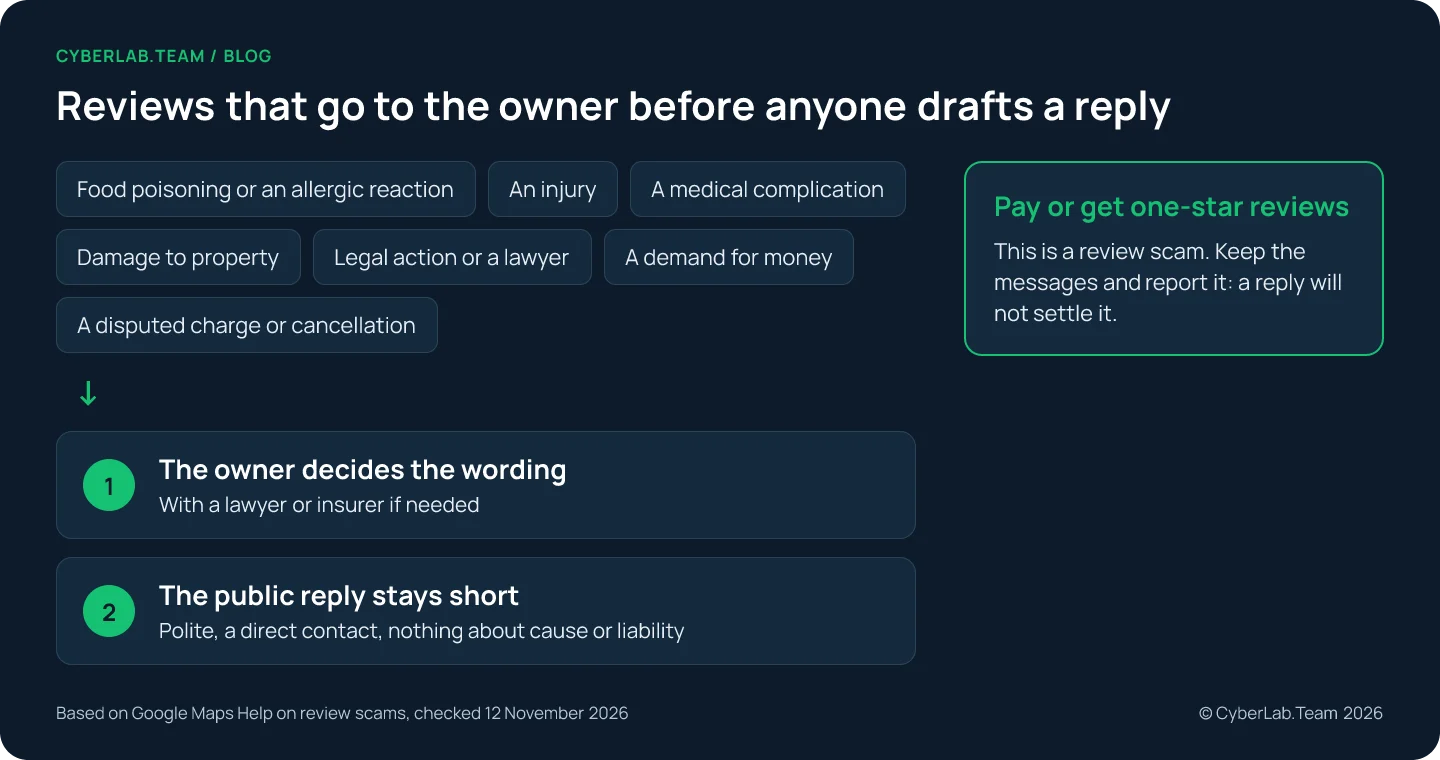
The industry examples above flag these cases where they occur. They share one feature: anything said in public may later be read as an admission or a promise. A short, polite reply that offers a direct contact and says nothing about cause or liability is usually the most that should appear on the profile.
A different kind of review needs a different route altogether. Google describes review scams in which someone threatens to leave one-star reviews until the business pays. A reply will not settle that: preserve the messages and follow the route in our guide to unwanted reviews. Google removes only reviews that break its policies, and a review you simply disagree with does not qualify.
Does replying change anything?
Replying tends to help, with limits. Studies of hotel reviews found more reviews and slightly higher ratings after managers began replying, and another study found that replies can also draw more negative reviews. Surveys of consumers say most people expect a reply, and half are put off by replies that look templated.
Davide Proserpio and Georgios Zervas studied hotel reviews on TripAdvisor (Marketing Science, 2017). After hotels started responding, they received 12% more reviews and their average rating rose by 0.12 stars; negative reviews became less frequent but longer, according to the summary published with the study.
Judith Chevalier, Yaniv Dover and Dina Mayzlin looked at the same question from the other side (NBER working paper, 2017; Marketing Science, 2018). They found that management replies stimulate reviewing, particularly negative reviewing, because managers reply more often and at greater length to negative reviews. Dover’s explanation, quoted in the study’s press summary, is that reviewers write partly to influence the manager, and a reply shows that someone is reading.
For consumer expectations, BrightLocal’s Local Consumer Review Survey 2026, a panel of 1,002 adults in the United States, found that 89% expect owners to respond and 81% expect a reply within a week. Half said they were unlikely to use a business whose replies are templated or generic. Our chart-by-chart reading of that survey covers the rest.
None of this measures Google Maps rankings or sales for a particular business, and none of it covers clinics or law firms. Take the direction from the research and judge your own results against the record you keep.
Templates and AI drafts
A template is a starting point. The examples above show the structure for each case; the reply that goes out should mention what this reviewer actually wrote, use your own voice and pass a fact check. That applies to replies drafted by AI as much as to replies copied from an article like this one.
Check every draft against four questions before it is published: is each fact true, does it add any detail the reviewer did not publish, does it promise anything the business has not decided, and would it still read well under twenty other replies. Google’s tips advise against sending the same thank you to everyone, and BrightLocal’s 2026 survey found templated replies put off half of respondents.
Keep the sensitive cases out of any automated flow. Replies in health care and law, and the reviews listed in the section above, should always pass a person who knows the rules the business works under.
Smaller questions
Four questions come up whenever a business starts replying: whether an agency may post replies, what to do with a star rating that has no text, whether a reply can be changed later, and whether replying does anything to the review itself.
Can an agency reply to reviews for us?
Yes, if you approve it. Google’s third-party policy requires an agency to have explicit approval to respond to reviews on a client’s behalf, and verbal consent is not enough. Keep the approval in writing or in a digital form you can show later.
Should I reply to a rating with no text?
A short thank you is enough, and it can be the place where you vary wording the most. There is nothing to respond to beyond the rating, so the reply should not invent details about the visit.
Can I change a reply after it is published?
Yes. Open the profile, select Read reviews and edit or delete your reply. The reviewer can also edit the review at any time, so a reply that answered the first version may need updating.
Does a reply remove or hide a negative review?
No. A reply sits under the review and does not change it. Google removes only reviews that break its policies, and the route for those is described in our guide to unwanted reviews.
If replying to reviews is the part of the profile your team keeps postponing, monthly profile management includes drafting replies within the rules for your trade, with the sensitive ones sent to you first.
Sources
Google help pages checked 12 November 2026. Studies and regulatory decisions are listed with their dates.
- Google Business Profile Help. “Manage customer reviews.” https://support.google.com/business/answer/3474050
- Google Business Profile Help. “Tips to get more reviews.” https://support.google.com/business/answer/3474122
- Google Maps Help. “Prohibited and restricted content.” https://support.google.com/contributionpolicy/answer/7400114
- Google Business Profile Help. “Report an inappropriate review.” https://support.google.com/business/answer/4596773
- Google Business Profile Help. “About reviews for service businesses.” https://support.google.com/business/answer/9950987
- Google Business Profile Help. “Business Profile third-party policies.” https://support.google.com/business/answer/7353941
- Google Business Profile Help. “Business Profile restrictions for policy violations.” https://support.google.com/business/answer/14114287
- Google Maps Help. “Identify scams on reviews and ratings.” https://support.google.com/maps/answer/14014039
- Google. Ian Leader, “How reviews on Google Maps work,” 2 February 2022. https://blog.google/products/maps/how-google-maps-reviews-work/
- Information Commissioner’s Office. “What is special category data?” https://ico.org.uk/for-organisations/uk-gdpr-guidance-and-resources/lawful-basis/special-category-data/what-is-special-category-data/
- Agencia Española de Protección de Datos. Resolution on appeal, file EXP202206316 (PS/00122/2023), November 2023. https://www.aepd.es/documento/reposicion-ps-00122-2023.pdf
- Nixon Peabody. “HIPAA-regulated entities must use caution responding to online reviews,” 13 July 2023. https://www.nixonpeabody.com/insights/articles/2023/07/13/hipaa-regulated-entities-must-use-caution-responding-to-online-reviews
- California Dental Association. “Dental practice pays $10K to settle disclosures of patients’ PHI on social media,” 10 October 2019. https://www.cda.org/news-events/dental-practice-pays-10k-to-settle-disclosures-of-patients-phi-on-social-media
- ABA Journal. “Lawyers must use caution when responding to negative online reviews, new ethics opinion says,” 13 January 2021. https://www.abajournal.com/news/article/lawyers-must-use-caution-responding-to-negative-online-reviews
- Federal Trade Commission. “Federal Trade Commission Announces Final Rule Banning Fake Reviews and Testimonials,” 14 August 2024. https://www.ftc.gov/news-events/news/press-releases/2024/08/federal-trade-commission-announces-final-rule-banning-fake-reviews-testimonials
- Proserpio, D. and Zervas, G. “Online Reputation Management: Estimating the Impact of Management Responses on Consumer Reviews,” Marketing Science, 2017; summary on Phys.org, 11 September 2017. https://phys.org/news/2017-09-business-online.html
- Proserpio, D. and Zervas, G. “Study: Replying to Customer Reviews Results in Better Ratings,” Harvard Business Review, 14 February 2018. https://hbr.org/2018/02/study-replying-to-customer-reviews-results-in-better-ratings
- Chevalier, J., Dover, Y. and Mayzlin, D. “Channels of Impact: User Reviews when Quality is Dynamic and Managers Respond,” NBER Working Paper 23299, 2017. https://www.nber.org/papers/w23299
- ScienceDaily. “Is replying to online reviews always good? New research shows downside of over-responding,” 3 October 2018. https://www.sciencedaily.com/releases/2018/10/181003134518.htm
- BrightLocal. “Local Consumer Review Survey 2026,” 11 February 2026. https://www.brightlocal.com/research/local-consumer-review-survey/


